Polkadot hits all-time high in development activity in Q3 amid plans to become world’s fastest blockchain
POLKADOT, the multichain ecosystem home to Web3’s boundary-pushing builders, has continued to raise the bar in terms of interoperability and development activity in Q3.
 By Polkadot•October 16, 2022
Polkadot, the multichain ecosystem home to Web3’s boundary-pushing builders, has continued to raise the bar in terms of interoperability and development activity in Q3.
A new all-time high for developer contributions was reached in August, and then beaten in September — when Polkadot had more activity than any other network, including Ethereum. GitHub data shows, on average, more than 500 individual contributions were provided every day in the final month of Q3.
Meanwhile, XCM, the Polkadot’s innovative and secure cross-consensus messaging standard, has picked up the pace: parachains continue to open new channels to enable easy interoperability, while seeking to build new Web3 use cases. Data from Polkadot Subscan shows August had an all-time high number of 26,258 XCM messages sent.
There was extra excitement within the community surrounding future plans as Polkadot founder Rob Habermeier published a roadmap outlining a series of new in-development features.
These included a proposal that would give the network capacity to process up to one million transactions per second, which would represent a new pinnacle for Web3.
The positive adoption metrics for Polkadot come even as the industry-wide downtrend showed few signs of imminent recovery amidst wider macroeconomic concerns.
By the end of September 2022, the following milestones were reached by Polkadot’s growing ecosystem:
- Some 14,930 developer contributions were recorded for August, setting a new monthly all-time high by a wide margin. That record lasted for a matter of weeks before Polkadot crossed the 15,000 mark for the first time in September. The month finished with 15,433 contributions, the highest recorded on any network, including Ethereum.
- New parachains continued to be launched on a regular basis. There are currently 40 active parachains on the experimental “canary” network, Kusama, and 26 on Polkadot itself.
- Many parachains have been making use of Polkadot’s novel cross-chain interoperability standard, XCM (cross-consensus messaging). So far, well over 140,000 messages have been exchanged between chains via 135 messaging channels as the chains collaborate to seek real-world solutions through interoperability.
- The Web3 Foundation grants program, supporting Polkadot projects, supported an additional 37 projects during Q3, with total grants since inception approaching 500.
- The Polkadot Treasury has funded spending proposals to the tune of over 9.6 million DOT, while the Kusama treasury has paid out nearly 346.7k KSM.
Roadmap published, Polkadot heading for up to one million transactions per second
Polkadot founder Rob Habermeier produced an important update on proposals for a series of major upgrades to enhance scalability. He highlighted Asynchronous Backing, which will cut the block time for parachains from 12 seconds to six and increase block space five to 10-fold. This will increase the amount of work every chain can do and optimize network performance, allowing scope for more parachains. It’s also estimated this will take the transactions-per-second capacity of the network to between 100k and one million without affecting security. Asynchronous Backing is slated for deployment on Kusama by EOY 2022 and then on Polkadot, pending the results of audits and testing.
Meanwhile, parathreads – “pay-as-you-go” parachains that combine the power of starting a blockchain with the ease of launching a smart contract – are estimated to be ready for launch early next year. Parathreads will make it easier than ever before to build in the Polkadot ecosystem, providing a simple entry point for launching a Layer 1 chain on top of Polkadot and will be just as secure as full parachains. In addition, they can be seamlessly upgraded into full parachains with guaranteed capacity.
Polkadot the most decentralized network among peers, according to Messari
Messari, a leading provider of Web3 data, noted a particularly high Nakamoto Coefficient number for Polkadot. This is an indication of the number of nodes that must be compromised to affect the blockchain and prevent it from functioning correctly. A high Nakamoto measure indicates a network that is highly decentralized, and Polkadot’s score is impressive compared to other networks.
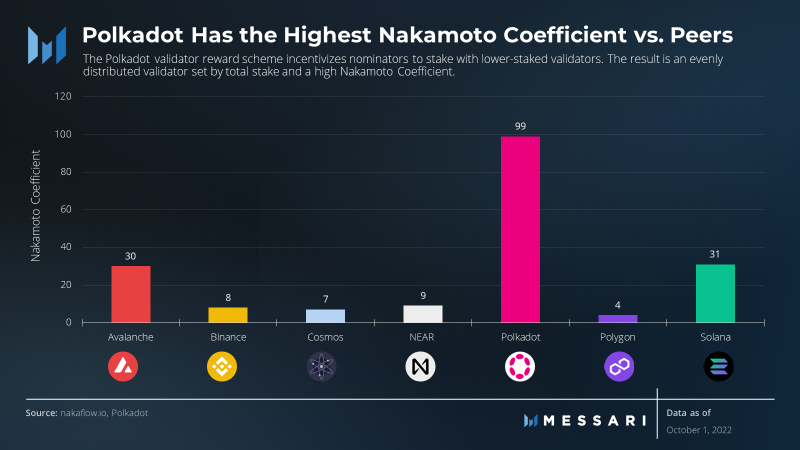
Messari, issuing its own ‘State of Polkadot’ report, observed: “Q3 was another consistent quarter for Polkadot’s decentralization and staking. Fundamental metrics like validator count, percentage of total supply staked, and the minimum DOT required to run an active validator were stable. Consistency in decentralization and staking related metrics point to a functioning and healthy ecosystem.”
Two largest stablecoins come on board
In September, Tether Operations Limited announced the launch of its native Tether (USDT) tokens on Polkadot. Paolo Ardoino, CTO at Tether, commented: “Polkadot is on a trajectory of growth and evolution this year and we believe Tether's addition will be essential in helping it continue to thrive.” Tether was minted on Polkadot’s system parachain Statemint on September 23rd.
In the same week, Circle Internet Financial, the firm behind USD Coin (USDC) announced that it would expand the circulation of USDC to Polkadot. Joao Reginatto, VP of Product at Circle, said this move “...enables blockchain developers building on USDC and their users to experience greater liquidity and interoperability within the crypto economy.” USDC is due to be integrated by the end of the year.
About Polkadot
Polkadot provides the technical advances necessary to make blockchain technology practical, accessible, scalable, interoperable, and future-proof, removing limitations and barriers to entry, and thereby fuelling innovation, growing the decentralized technology space, and bringing the Web3 vision to life.
About Web3 Foundation
Web3 Foundation funds research and development teams building the technology stack of the decentralized web. It was established in Zug, Switzerland by Ethereum co-founder and former chief technology officer Dr. Gavin Wood. Polkadot is the Foundation's flagship project. For more information, visit web3.foundation
Media inquiries: press@parity.io