Skip to main content
Polkadot logo

Explaining the Polkadot Launch Process

The Polkadot network will have a phased roll-out plan, with important milestones toward decentralization marking each phase in the process.

By PolkadotMay 8, 2020

By: Logan Saether and Joe Petrowski

The Polkadot network will have a phased roll-out plan, with important milestones toward decentralization marking each phase. For more detail on each step in the process, watch the explanation from Polkadot and Kusama founder Gavin Wood included at the end of this article.

The Polkadot launch process begins when Web3 Foundation launches the first chain candidate, which is a proposal for a Polkadot Relay Chain. The initial chain has a restricted runtime that is limited to basic operations in order to gain confidence in the network’s stability. These limitations will be lifted through a series of governance decisions.

Polkadot Network Launch Phases
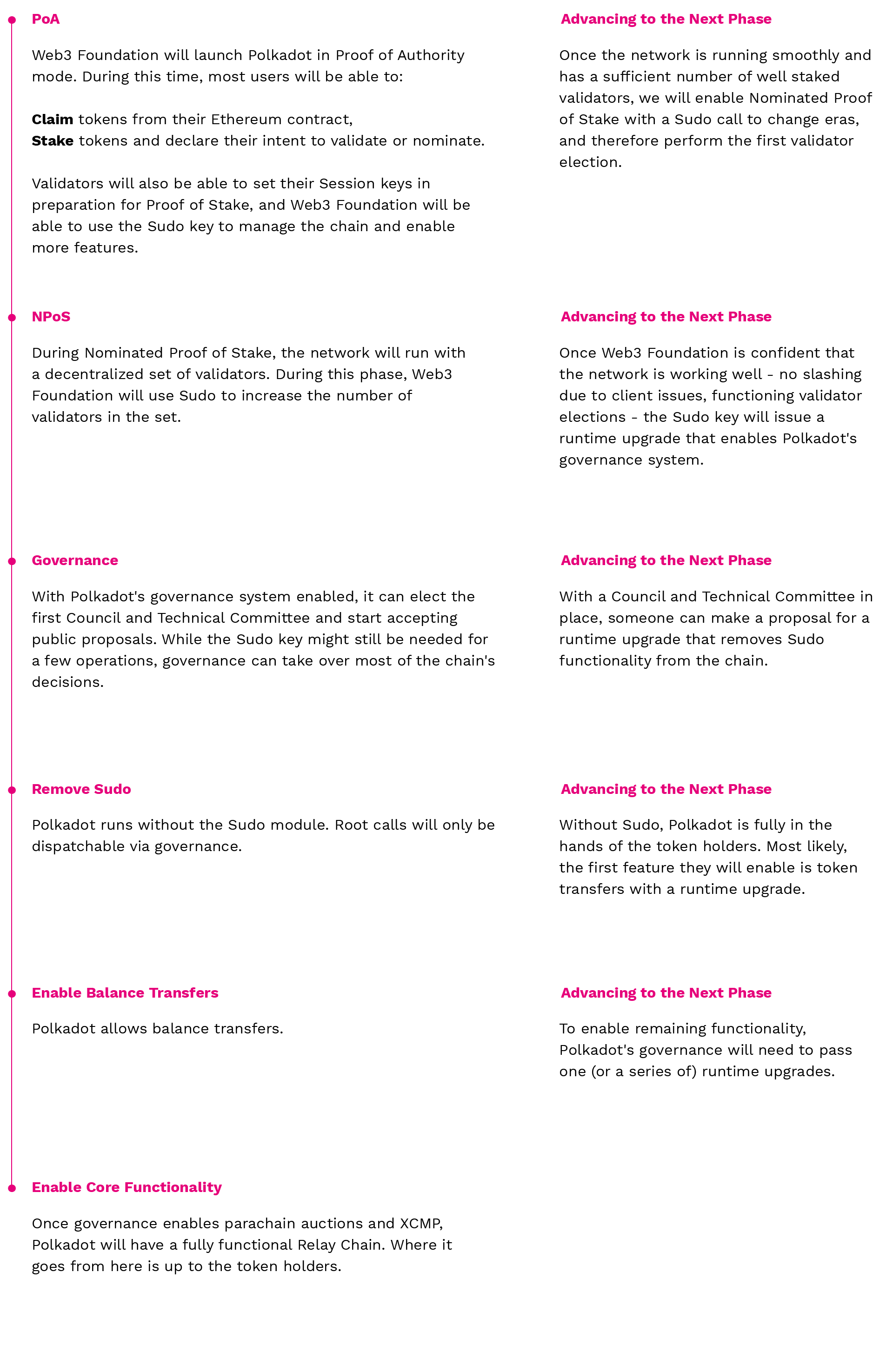
PoA

During the first phase, Polkadot will operate as a Proof-of-Authority (PoA) chain that is maintained by six validators belonging to Web3 Foundation. The chain’s limitations will only allow users to claim DOT tokens as well as submit their intention to validate or nominate.

NPoS

Once Web3 Foundation is confident in the stability of the network and there are a sufficient number of validator intentions, Web3 Foundation will use Sudo - a superuser account with access to governance functions - to initiate the first validator election. This election will transition the network from PoA into its second phase, Nominated Proof of Stake (NPoS), where the network is secured by the economic stake that is bonded to the validators.

Governance & Remove Sudo

After the chain is running well with a large validator set, the Sudo key will enable the suite of governance modules in Polkadot; namely, the modules to enable a Council, a Technical Committee, and public referenda. Once a Council and governance tools are in place, the public has the avenues to effect changes in the system.

A runtime upgrade initiated by public referenda will remove Sudo from Polkadot, leaving it in the hands of the token holders. Without Sudo, the chain will no longer be a candidate and will be a live, decentralized network.

Enable Balance Transfers & Core Functionality

The final stages of Polkadot’s rollout will involve unlocking the remaining functionality. One of the first post-Sudo upgrades will likely enable balance transfers in the network. After that, governance proposals will unlock the rest of Polkadot’s core functionality, like allowing the first parachains and cross-chain messages.

Learn More

To keep up with the Polkadot launch and everything else happening for the network, join the discussion on Telegram and Riot, or subscribe to the newsletter. Learn more about Polkadot in the Polkadot Lightpaper and the Polkadot Wiki.

Update 08.01.2021
The Polkadot network was launched and parachains are live on the network.

From the blog

Polkadot Ecosystem Ignites 2025: A Year of Unprecedented Decentralization, DeFi Breakthroughs, and Global Builder Momentum

A quarter-by-quarter recap of Polkadot’s 2025 milestones, from record-breaking decentralization and DeFi growth to Polkadot 2.0 and global builder momentum.

Proof of Personhood: How Polkadot proves you're real without KYC

Proof of personhood lets you prove you're a unique human without giving up privacy. Polkadot's Project Individuality uses tattoos and video games to fight bots and enable fair airdrops for millions.

Pudgy Party: The Web3 game that hides the blockchain

Pudgy Party hit 900,000 downloads in six weeks by hiding the blockchain entirely. Built on Mythos Chain, players get custodial wallets and zero gas fees without realizing it. The game proves Web3 gaming works when blockchain infrastructure becomes invisible.

Polkadot at TechCrunch Disrupt 2025: The only blockchain in the room

Polkadot showed up at TechCrunch Disrupt 2025 as the only blockchain sponsor. With nearly 10,000 booth visitors and strong coordination across ecosystem teams, the event proved valuable for positioning Polkadot in Web2 conversations.

Why most blockchains can't handle AI (and what changes that)

Most blockchains can't handle AI's computational demands. High costs, limited speed, and storage constraints require purpose-built modular infrastructure instead.

Onboarding 21,000 users with Nova Shots: What we learned & how we move forward

How do you bring thousands of esports fans onchain without asking them to buy anything first? At three BLAST Counter-Strike events, Nova Wallet onboarded 21,000 new users through free interactive gameplay, processing 2.8 million transfers on Polkadot.

Meet the first cohort: The 5 teams selected for the DeFi Builders Program

Velocity Labs announces 5 teams selected for the DeFi Builders Program Cohort 1, building innovative financial applications on Polkadot Hub.

5 tech outages that prove decentralization can't wait

From AWS to CrowdStrike, major outages are increasing. Discover why centralized infrastructure keeps failing and how decentralization offers a solution.

Real World Assets on Polkadot: Your comprehensive guide to RWA

Real-World Assets bring physical value onto blockchain. Learn what RWAs are, how tokenization works, and why Polkadot is best for RWA projects.

Q3 2025 Polkadot DAO recap: Supply cap, treasury decisions & what's next

Here's what happened in Polkadot governance during Q3 2025: a permanent supply cap, millions in treasury funding decisions, and notable proposal rejections that exposed growing pains in how the DAO evaluates non-technical work.

Building AI on Polkadot: Why centralized compute is the wrong foundation

Build AI on Polkadot with verifiable data, cryptographic privacy, and native interoperability. 90% cost savings, no vendor lock-in, production-ready.

What Does Web3 Music Success Actually Look Like?

The Decentralized Mic brought together builders and investors actively shaping the future of Web3 music to discuss what's working, what's broken, and where the industry is headed next.

xs