
Kusama And Polkadot Now Reward Curators Helping To Scale Councils Functions: Join The Force Moving the Community Forward!
The new Bounty Extension on Polkadot and Kusama allows curators to autonomously allocate Treasury funds to projects that bring value to the ecosystem.
 By Polkadot•October 9, 2020
By Raul Romanutti, Council Member and Project Manager at Parity Technologies
The new Bounty Extension on both networks allows curators to autonomously allocate funds to projects that bring value. With everything happening on-chain, this is an efficient way to administer Treasury funds, boosting the Polkadot ecosystem and giving more autonomy to those curating their development. The new extension works as a budget mechanism aiming to help the Councils scale their tasks.
Current mechanisms
In the early days of Kusama and Polkadot, Treasury funds were used inefficiently: primarily due to the need of off-chain mechanisms to design and plan Treasury proposals, but also because of the difficulty in coordinating Council activities quickly in order to keep both treasury fundings moving. This is now changing through new spending mechanisms.
Originally envisioned on the Kusama network, both Councils have long been looking for new ways to scale its activities and fund new projects that bring added value to the community. The original design intended two ways to spend Treasury funds:
Tipping: Tips can be suggested by anyone holding KSM or DOT (the native tokens on the networks) and are endorsed by Council members. Tips do not have any fixed value: The final value is decided based on the median of all tips issued by the councillors. We have used this mechanism to reward the work of community members who developed something valuable or creative, assisted in education by translating resources, supported evangelism efforts in social media or even produced branded ceramics!
Spending Proposals: The Treasury is also used to fund spending proposals submitted by community members. These need to be approved by the Council and have the goal of developing ideas that give traction to the network, maintaining infrastructure deployment, security operations, and marketing activities, among others. Learn more about some of the projects building with Kusama Treasury funding and about the first teams building with support from the Polkadot treasury.
The discussion on the need for new mechanisms to keep the Treasury active came from the Kusama community itself: the general feeling was there are practical limits to Council member curation capabilities: While individual councillors may have the expertise required to make a proper assessment of the activities described in Treasury proposals, that is unlikely to be the case for a majority of members. An open conversation on this subject resulted in a proposal to extend the treasury pallet, allocating funds for projects token holders think are important.
New Horizons
One of the new mechanisms proposed is a Treasury Bounty mechanism (originally described here) aiming to avoid one of the stagnating factors of treasury spending: project curation. This is achieved by delegating the curation activity of spending proposals to an expert called a curator. This mechanism has now been added to the treasury pallet and is ready to be used by KSM and DOT holders.
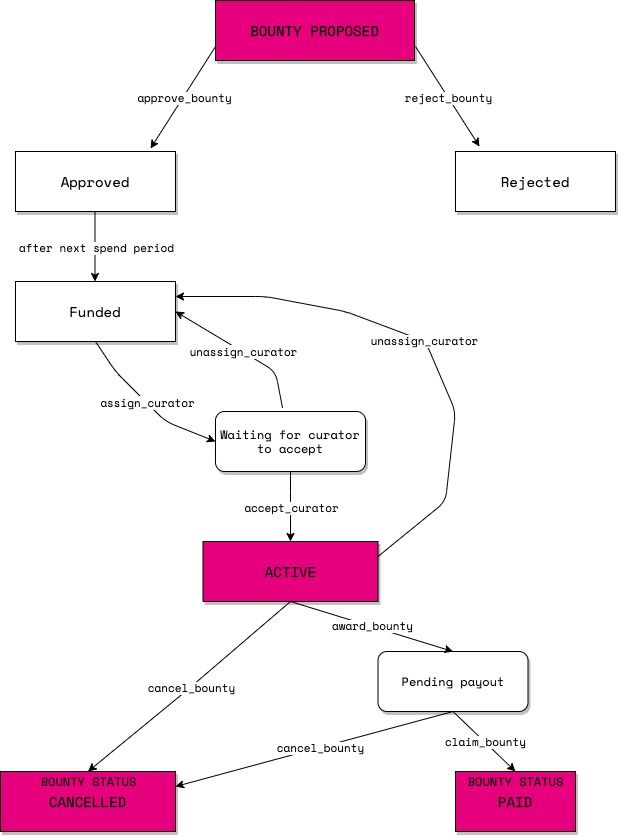
A bounty spending includes a proposer, a reward, a description and a curator. Curators are selected by the Council after the bounty proposal is approved and funded. Curators can be defined as addresses with agency over a portion of the Treasury, with the goal of fixing a bug, vulnerability, or monitoring a set of tasks related to a specific topic.
In this sense we introduce a two-step approval mechanism. First, the Council approves the bounty allocation. Second, the body decides on a curator to take the responsibility for the assignment: once the curator accepts the position, they make a deposit. The deposit can be used to punish them if they act maliciously, but if they are successful in their task of getting someone to complete the bounty work, they will receive their deposit back along with part of the bounty as a reward.
After the bounty proposal is approved by a simple majority of the Council and the curator is elected, it becomes an active bounty and the amount destined to its payment will be locked in the Treasury, earmarked for this purpose only. Any token holder can submit a bounty proposal and set a reward. Similar to the tipping mechanism, bounty proposals require a deposit calculated as a base fee added to a byte fee per reason length.
The curator is expected to have a good track record related to the issues the bounty tries to resolve: they should at least be knowledgeable on the topics the bounty deals with and show project management skills or experience. Thus, competent curators are appointed, ensuring an effective use of the bounty mechanism.
The curator closes the bounty after all milestones have been reached. This process enacts two delayed payouts: one to the address of the user who completed the tasks and another to the curator's address.
Of Curators, Bounty Proposals and the Role of the Councils
The introduction of curators allows the Council to extend their authority over a portion of the Treasury without permanent supervision over how funds are spent. By selecting a curator, the community suggests a specific user or group of users (Multisig) to administer funds that can only be used to pay for the completion of the specific goals included in the bounty proposal. In this sense and by approving several bounties, each with a different curator, the Council is virtually creating high-level budgets. If the bounty is curated by a Multisig, the result is similar to a topic-based mini council: a group of users supervising the execution of tasks on a specific topic and rewarding those who complete them.
The new mechanism starts from the idea that initiative, ownership and responsibility originate in individuals. By separating the curation tasks from other Council responsibilities, the number of simultaneous activities scales while keeping the Treasury moving.
The Treasury allows many active bounties and curators simultaneously. This new mechanism also grants curators the freedom to work autonomously on the preferred direction of the tasks with the teams involved, and enact payment after. To further enhance their work, curators can ask the Council or any contributors to top-up the active bounty to extend the work done. In the future, it is expected that they will be able to divide the allocation into sub-bounties and work with different teams as needed.
However, certain limits are set in place with the goal of avoiding bad behavior: both Kusama and Polkadot Councils are allowed to cancel any payment during the delayed payout period (the period between the bounty being awarded and the reward being claimed) or unassign the curator to the earmarked funds if they do not fulfill expectations. After all, they should be held accountable if they wish to take up the responsibility of managing funds from the community.
Join the Kusama community and make use of the new bounty spending mechanism for the Treasury
The new spending mechanism is ready to be used by token holders who want to help Councillors administer funds for the benefit of the community. Join the Kusama and Polkadot communities and add your voice to Treasury allocation. The new Bounty Extension complements the ongoing 'Building Polkadot' bounty challenge in collaboration with Gitcoin, and aims to eventually integrate efforts even further. There are plenty of ways to get plugged in to the communities. Join the discussion on the Kusama Official Telegram and Polkadot Official Telegram group and Element channels, or subscribe to Kusama's newsletter. Learn more about Kusama and Polkadot on our website and in the Wiki. Want to join the core growth team behind Kusama and Polkadot? Join the Ambassador Program.