
Kusama & Polkadot: Comparing the Cousins
As the launch of Polkadot draws near, many are asking how the network will compare to Kusama and how both will be used in different ways going forward.
 By Polkadot•April 16, 2020
Kusama and Polkadot are independent, standalone networks built on very similar codebases, but Kusama has faster governance parameters and lower barriers to entry. While Kusama is wild and fast, Polkadot is more conservative, prioritizing stability and dependability, with slower, more methodical governance and upgrade processes. Kusama is great for bold experimentation and early-stage deployment. Polkadot is designed for stable execution of risk-averse, high-value applications.
As the launch of Polkadot draws near, many are asking how the network will compare to Kusama and how both will be used in different ways going forward. Below we’ll explore a few of the key differences between them, and look at how use cases on Kusama are likely to differ from Polkadot as they both continue on as independent yet closely related networks governed by their own respective communities.
Kusama offers an early, adventurous version of Polkadot to allow teams and developers to build parachains and deploy applications in an environment with economic incentives that will mirror those on Polkadot. As a canary network, Kusama was created to warn us, as well as teams building for Polkadot, of any major issues before launch of and deployment to the higher-stakes environment of Polkadot (Polkadot is going through several rounds of security audits prior to launch to ensure there are no surprises). In this sense, Kusama plays an important role in securing and stabilizing Polkadot for more risk-averse applications.
Technical comparison
Because governance on Polkadot and Kusama is decentralized and permissionless, the networks will evolve independently, converging or diverging over time according to the decisions of their respective communities. However, at the time of writing this article, there are a few important distinctions to be made.
First, let's start with what the two networks share in common. Kusama was released as an early version of the same code to be used in Polkadot, which means they share the same underlying architecture: a multichain, heterogeneously-sharded design based on nominated proof of stake (NPOS). They also share key innovations like on-chain governance, hot-swappable runtimes for forkless, on-chain upgrades, and cross-chain message passing for interoperability. That is to say, Polkadot and Kusama share the vast majority of their underlying technology.
Speed
The first key technical difference between Polkadot and Kusama is that Kusama has modified governance parameters that allow for faster upgrades. This does not mean that the blockchain itself is faster, in the sense of faster block times or transaction throughput (these are the same on both networks), but that there's a shorter amount of time between governance events such as proposing new referenda, voting, and enacting approved upgrades. This allows Kusama to adapt and evolve faster than Polkadot.
Why make governance faster on Kusama than on Polkadot? Polkadot isn't just cutting edge technology, it's bleeding-edge technology. Building Polkadot is like going out to explore uncharted territory: it's full of unknown hazards, challenges, and detours. With its ability to evolve and adapt at a faster pace, Kusama races forward like a scout, surveying the landscape ahead, occasionally running into danger and stumbling along the way. Thanks to Kusama’s reconnaissance, Polkadot can move slowly and calmly ahead, safe from the pitfalls that Kusama experiences and reports back.
But Kusama's increased speed also means stakeholders need to stay active and vigilant if they want to keep up with all the proposals, referenda, and upgrades. Kusama is up to four times faster than Polkadot will be, with seven days to vote on referendums and eight days to implement those upgrades after a vote. This means validators on Kusama often need to update on short notice. On Polkadot, by contrast, validators will have up to one month to complete scheduled upgrades, which may be a strong incentive for those who prefer a smoother experience.
Lean setups
Kusama will have a lower barrier to entry for developer teams that wish to deploy as a parachain, as the network will likely have a lower bonding requirement than Polkadot. Validators will also benefit from Kusama, which offers an opportunity to refine their validation infrastructure. Kusama validators can also benefit from the 1000 Validators Program, which helps them kickstart their Kusama nodes with nominations from Web3 Foundation and Parity Technologies. For those who want to validate on Kusama and Polkadot, the same setup and infrastructure can be used for both networks.
Use cases
Polkadot is and always will be the primary network for the deployment of enterprise-level applications and those that entail high-value transactions requiring bank-level security and stability. However, Kusama will maintain several ongoing use cases after Polkadot has launched, and will likely be a place where we see some exciting experimentation with new technologies going forward.
Kusama provides a live, fully decentralized and community controlled network with real-world conditions and incentives. The initial use case for Kusama is as a pre-production environment, whereby projects maintain parachains on both networks, experimenting and testing new technologies and features on Kusama before deploying them to Polkadot. This is where Kusama gets its designation as a canary network, as experimentation on Kusama will provide a more accurate understanding of how a particular parachain, blockchain component, or validator setup will perform under real-world conditions, with lower stakes in the event of problems or bugs than on Polkadot. Projects like Acala and Moonbeam have already mentioned this as one of their main reasons for deploying to Kusama.
Another major use case for Kusama is as an early-stage network for newer, less-established teams that are still iterating on their technology and business model. Deploying a parachain to Kusama’s lower-stakes environment will give developers increased flexibility while they finalize the design of their platform, build their user base and gain traction in the community. Polkadot then acts as an upgrade path for those projects that eventually become more mature, established businesses. Projects that require high-throughput but don’t necessarily require bank-like security, such as some gaming, social networking, and content distribution applications are particularly good candidates for this use-case.
Kusama may also prove to be the perfect environment for ambitious experiments with new ideas and new innovations in areas like governance, incentives, monetary policy, and DAOs (decentralized autonomous organizations). Kusama's more exploratory spirit will also likely lead to some interesting experimentation via Kusama governance and the community at large, who can use the Kusama treasury as a capital base for trying out novel incentive structures to foster community interest and involvement. Kusama has already garnered a strong community of dedicated enthusiasts, with some going as far as getting tattoos of the Kusama canary logo.
Future upgrades to Polkadot’s own runtime will also likely be deployed to Kusama before Polkadot mainnet. This way, not only will we be able to see how these new technologies and features will perform under real-world conditions before bringing them to Polkadot, but teams who have deployed to both networks will also get an advanced look at how their own technology will perform under those upgrades.
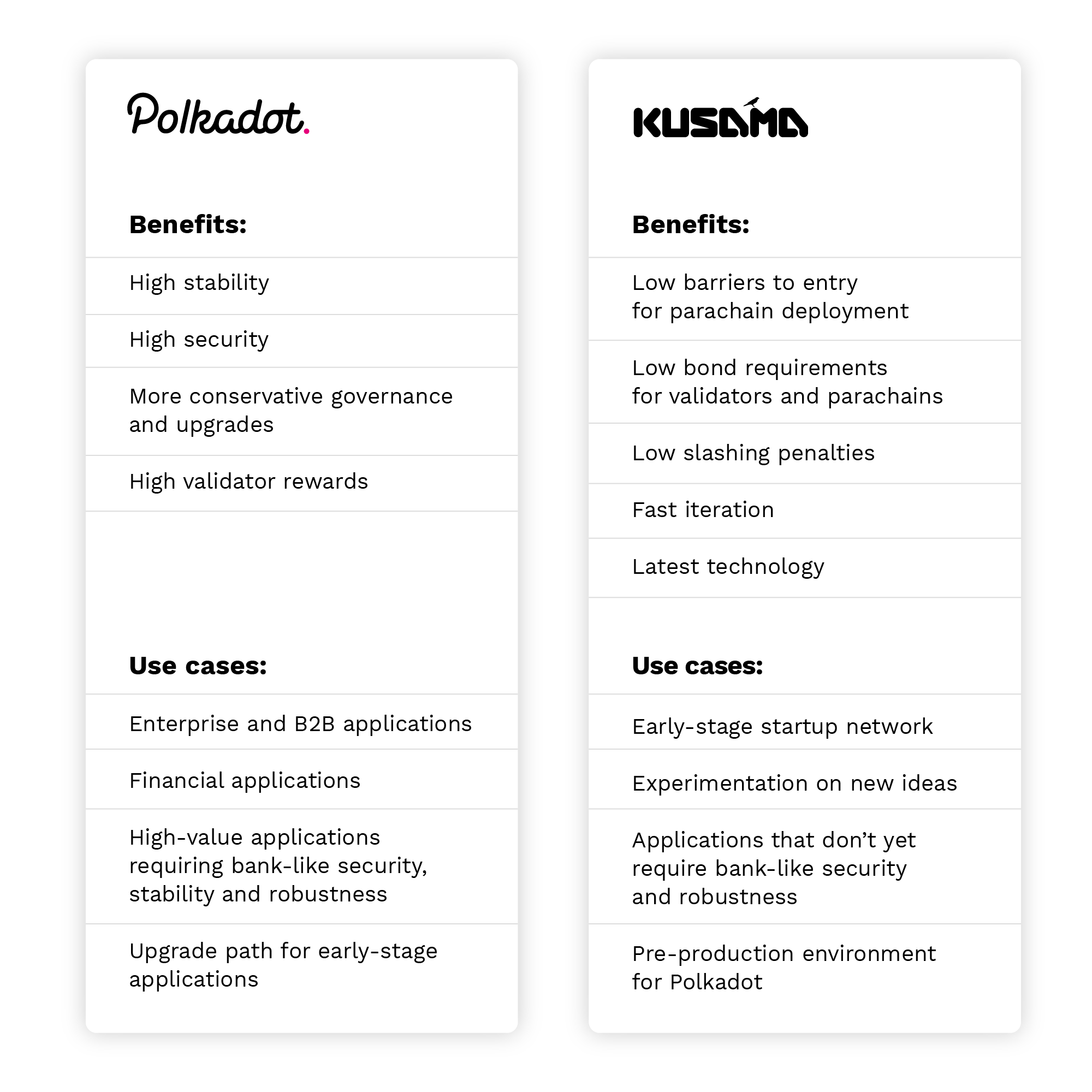
Ultimately, Kusama and Polkadot will live on as independent, standalone networks with their own communities, their own governance, and their own complementary use cases, though they will continue to maintain a close relationship, with many teams likely deploying applications to both networks. In the future, we’re also likely to see Kusama bridged to Polkadot for cross-network interoperability. Web3 Foundation and Parity Technologies will remain committed to both networks going forward, providing crucial support and guidance to teams building for the ecosystem. Kusama will continue to play its initial role as a canary network, helping ensure that Polkadot remains as reliable, stable, and secure as it needs to be as the future of the decentralized web. Where Kusama goes from here is up to you…
To stay informed on Polkadot's launch, subscribe to our newsletter.