
Polkadot 1.0: Pioneering Blockspace Composability and Scalability
Polkadot version 1.0 has been completed and released, representing the culmination and completion of the pioneering vision outlined in the Polkadot whitepaper.
 By Polkadot•July 19, 2023
A significant milestone in the evolution of blockchain technology has now been reached – the official release of the completed version of Polkadot 1.0, inclusive of all the functionality outlined in the Polkadot whitepaper. As a pioneer in the space, Polkadot has consistently led the charge in advancing blockchain interoperability, scalability, and resilience. The completion of Polkadot 1.0 represents a journey from the conception of a radically new approach to blockchain architecture to the delivery of a secure, composable, flexible, efficiently-allocated and cost-effective blockspace ecosystem.
The Polkadot 1.0 version release represents the realization of Polkadot's pioneering vision in blockchain technology, which was initially introduced in the Polkadot whitepaper with the concept of a ‘scalable heterogeneous multi-chain’ network in 2016. Recent years have seen the launch of all the functionality outlined in the whitepaper, and the 1.0 release represents the culmination and completion of all that work.
The Polkadot codebase is now functionally complete and has been fully handed over to the community with the launch of Polkadot OpenGov and the migration of all runtime code to a repository managed by the Technical Fellowship.
The journey so far
The journey from the Polkadot Whitepaper to Polkadot 1.0 represents a major investment in solving some of the hardest problems in the blockchain technology space. From its initial phases, Polkadot set out to challenge the status quo of chain maximalism, breaking down the barriers between disparate blockchains and bringing them together into a single, securely-interoperable ecosystem. Polkadot 1.0 has paved the way to optimizing blockspace usage for greater transaction efficiency and scalability, making great strides in solving the blockchain trilemma of security, scalability, and decentralization.
Polkadot 1.0 features
The completion of Polkadot 1.0 signifies the realization of several commitments originally outlined in the Polkadot whitepaper. It delivers Polkadot’s initial architecture based on heterogeneous sharding, comprising the Relay Chain and connected parachains, all secured by a shared validator set. It also includes core features outlined in the whitepaper such as an advanced staking system, on-chain governance, cross-chain communication and transaction routing, forkless upgrades, and more.
Recent upgrades included as part of Polkadot 1.0 introduce significant enhancements on top of this, including dispute slashing, Polkadot OpenGov, and “Long Term Support” (LTS) releases. Dispute slashing, a crucial security feature, penalizes validators that approve invalid parachain blocks. This further strengthens Polkadot’s shared security model, a key benefit of Polkadot that ensures every parachain in the network gets the same high-level of security as the Relay Chain.
Polkadot OpenGov is a significant evolution of Polkadot’s original governance model (Gov1), which already represented the most advanced on-chain governance system when it was released in 2020. OpenGov introduces a new and improved approach to community-led decision-making, taking Polkadot’s advanced governance system a step further by implementing enhanced governance mechanisms that foster greater transparency, decentralization, safety, efficiency, and participation from the community. It also makes the governance process faster, more adaptable, and collaborative. This upgrade showcases Polkadot's commitment to continuous improvement, enabling the network to evolve and adapt to the ever-changing needs of its users while maintaining a strong emphasis on decentralization and community engagement.
Polkadot 1.0 also introduces “Long Term Support” (LTS) releases, ensuring critical security fixes for parachains without the need to upgrade to newer versions with breaking changes. The LTS releases will be maintained for 6 months, providing enterprises and users with prioritized stability and a secure parachain codebase.
With the official release of Polkadot 1.0, all runtimes have also been transitioned to a repository managed by the Technical Fellowship, marking a significant step forward in community governance. This move introduces greater transparency and encourages community participation, fostering an environment conducive to collaborative growth and development.
Along the journey to the completed Polkadot 1.0 release, a range of improvements in blockspace management were introduced that significantly enhance the development experience compared to other technology stacks, enabling developers to build more efficient and scalable applications. These improvements include enhanced resource allocation mechanisms, optimized transaction processing, and improved consensus algorithms. This results in increased transaction throughput, reduced latency, and improved scalability, ensuring a robust and secure environment for developers to build high-performance applications on Polkadot. By offering adaptable, developer-friendly blockspace, Polkadot fosters an ecosystem that encourages innovation and empowers developers to unleash their full creative potential.
Looking ahead
As we embark on a new era for Polkadot following the completion of Polkadot 1.0, the ecosystem is well positioned to continue leading the Web3 space forward in terms of innovation and pioneering technical achievements. Polkadot 1.0 has laid the foundation for Polkadot to take its place as the most secure, composable, flexible, efficient, and cost-effective blockspace ecosystem, enabling Web3’s boldest innovators to get their big ideas to market fast.
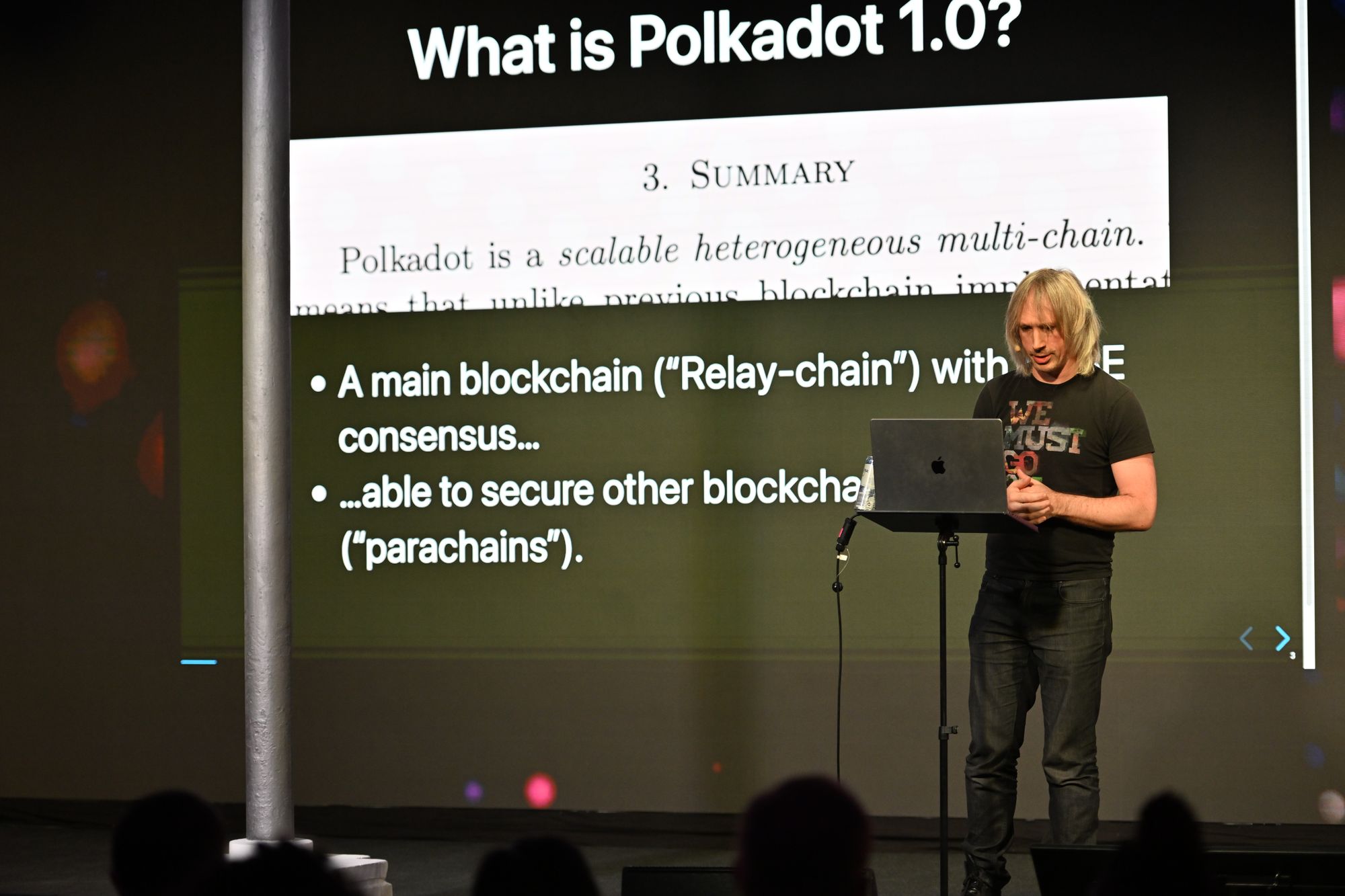
Where Polkadot goes from here is up to its community. While Polkadot 1.0 was based on a singular vision as set forth in the Polkadot whitepaper, the future of Polkadot will be determined around discussions and reaching consensus around multiple possible visions. Some ideas that could make up that future were recently proposed at Polkadot Decoded by Polkadot founder Gavin Wood, including additional, more flexible and capital-efficient mechanisms for allocating Polkadot’s blockspace beyond the parachain model, and an idea for creating opt-in ’treaty-like’ agreements between multiple blockchains called ‘accords’. These upgrades, if implemented by the community following discussions and refinement, would bring Polkadot’s value proposition closer to the end-user, cater to a wider range of needs, and more efficiently serve different stages of a product’s growth cycle.
Whichever path forward the community chooses, Polkadot is primed for continuous innovation and enhancement, driven by the foundational principles of future-proof upgradeability, interoperability and scalability.
The functionality released in recent years as part of Polkadot 1.0 represents a paradigm shift, signifying the emergence of a new era in which blockchains can securely and efficiently interoperate, each offering their own specialized functionality but united in a single composable blockspace ecosystem, offering Web3 developers unparalleled access to high-quality, flexible and available blockspace optimized for their needs.
Beyond the value that Polkadot 1.0 provides developers and innovators, it also represents an opportunity to get involved in the community and help shape the future of Web3, whether that’s getting involved with the developer community, joining the discussion on the Polkadot Forum, participating in Polkadot OpenGov, helping secure the network by staking, or applying for the Polkadot Blockchain Academy. By participating in the community, you can contribute to the future direction of Polkadot and support the movement to build a better web.
Interested in building on Polkadot? Talk to an expert for hands-on support.