
Polkadot Proof of Concept 4 arrives with new ways to stake
Polkadot Proof of Concept 4 arrives with new ways to stake In April, Polkadot’s Alexander testnet underwent a successful runtime upgrade that added new features to the Polkadot relay chain. Proof-of-Concept 4 is here and comes with new staking features that make running a validator on Polkadot much more secure and customizable.
 By Polkadot•May 20, 2019
Polkadot Proof of Concept 4 arrives with new ways to stake
In April, Polkadot’s Alexander testnet underwent a successful runtime upgrade that adds new features to the Polkadot relay chain. Proof-of-Concept 4 is here and comes with new staking features that make running a validator on Polkadot much more secure and customizable.
Staking
A healthy proof-of-stake system needs a high number of validators and a large percentage of capital locked up in staking to secure the network. Proof-of-Concept 4 introduces new staking features in Polkadot’s Nominated Proof-of-Stake (NPoS) system, including enhanced validator key management, new offline validator preferences and “off the table” rewards, making it easier for validators to securely validate on the network and incentivize participants in the network to nominate them.
Session keys for secure staking

Validators that choose to join the Polkadot network need ways to securely run their validator nodes without worrying about risking their staked DOTs in a hot wallet. In this fourth proof of concept, Polkadot introduces the “Stash” and “Controller” keys for secure staking of DOTs.
The goal of this new method is to keep validators’ funds secure and give them the option of where to send and how to use their rewards, ultimately providing an incentive for users to stake at a high rate and secure the network. The session key allows validators to separate their online node from their funds.
Giving validators greater control with new options
Polkadot’s NPoS system provides an incentive for validators to behave properly by punishing dishonest or unavailable validators. If a validator is found to be offline and unreachable by the network, a portion of their stake will be forfeit or “slashed”. This mechanism ensures that validators remain online to provide the network with security and availability of data at any moment.
Off the table
Nominated Proof-of-Stake allows rewards for participants who nominate validators they believe will be online and available to serve the security of the Polkadot network. Nominators back validators with their own stake, and get rewarded proportionally to the stake of the validator, after a fixed amount that a validator will decide to be “off the table.” This fixed amount may be used for the validator’s operating costs, which should cover sophisticated hardware and software upkeep to remain online with low latency, serving the network with valid and available blocks. The remainder of the block reward is distributed pro-rata amongst the validator and nominators.
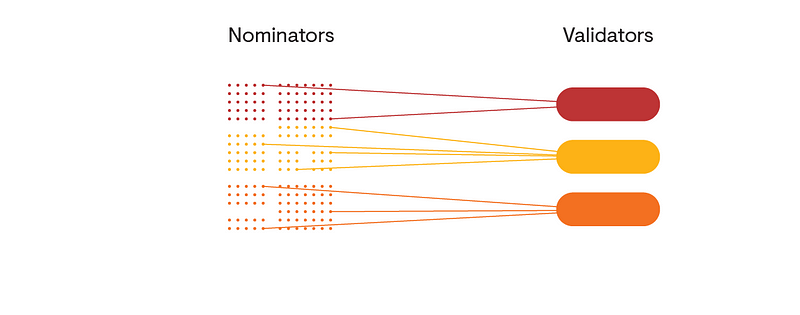
In PoC-4, Polkadot now gives validators the option to take DOTs “off the table.” Since nominators and the network are made aware of this, a validator’s amount “off the table” affects the way they are rewarded.
Validator slots are rewarded equally and the reward amount is determined according to the validator with the least amount of stake in the validator set. Therefore, a validator slot with a relatively large stake behind it divides the reward amongst many participants. By taking DOTs “off the table,” validators gain a greater share of the block reward, driving away nominators
Unlike rewards, validators and nominators are slashed proportionally to how much stake each validator has behind it. This means that validator slots with less stake behind them are more rewarding provided they remain online and produce valid blocks.
Giving validators these options aim to provide the Polkadot network’s NPoS system with a fair distribution and a high level of security. Read more about Polkadot’s Nominated Proof-of-Stake system on the wiki or Polkadot Blog.
Further improvements
There are many more under-the-hood features that have been added during the last few months, particularly networking improvements. The networking and messaging for GRANDPA, Polkadot’s consensus algorithm, has been greatly improved to allow for faster validator communication and finalization of the relay chain. Finalization times have currently been reduced to an average of 2 seconds, as shown on Polkadot’s telemetry website. Polkadot now also features PeerManager, a mechanism for easier debugging, reporting and monitoring so that peers can improve their connection rates.
What’s coming in Proof of Concept 5
Interchain message passing (ICMP) allows parachains to send each other all types of messages. This feature, core to the vision of Polkadot, is in the codebase of Proof of Concept 4 and will be finalized for Proof of Concept 5. Along with BABE, the Blind Assignment for Blockchain Extension, which should also be arriving with PoC-5, Polkadot will have its most significant features completed. A full audit of the codebase will follow, along with further audits of the game theory and consensus underlying Polkadot.
We are still targeting the initial release of Polkadot by the end of the year. Stay informed of Polkadot developments: follow @polkadotnetwork and r/dot and subscribe to the newsletter.