Build your own chain, your way: Meet the Polkadot SDK
The Polkadot SDK gives builders full control over blockchain development. Learn how teams use this modular, open-source framework to launch fast, secure, and interoperable networks.
 By Meesh Nguyen•June 6, 2025
What you can expect
- Learn what sets the Polkadot SDK apart
- Discover the core features and advantages that make the Polkadot SDK a top choice for developers
- Explore real-world examples of teams leveraging this framework to launch across a variety of real-world use cases
- Understand how Polkadot’s ecosystem lowers technical barriers to development
Blockchain development is changing fast. Today’s developers can choose to deploy smart contracts on established networks or architect specialized blockchains with custom logic, governance, and native interoperability. In a multichain landscape, demand is rising for tailored solutions and builders now expect flexibility to shape every layer, adapt quickly, and innovate at the protocol level.
The Polkadot SDK makes this depth of control accessible to anyone who wants to own their infrastructure from end to end. Purpose-built for modularity, the SDK’s production-grade framework gives teams more control over their tech stack, making it possible to launch everything from rollups and sovereign chains to complex cross-chain applications, without starting from scratch. Whether you’re building a DeFi rollup, a coordination layer for a DAO, or an AI-native chain, this flexible toolkit makes anything possible.
What is the Polkadot SDK?
The Polkadot SDK is an open-source, modular toolkit for building composable, production-ready blockchains. By combining several core technologies into a single framework, it gives teams the tools and flexibility to accelerate time to mainnet.
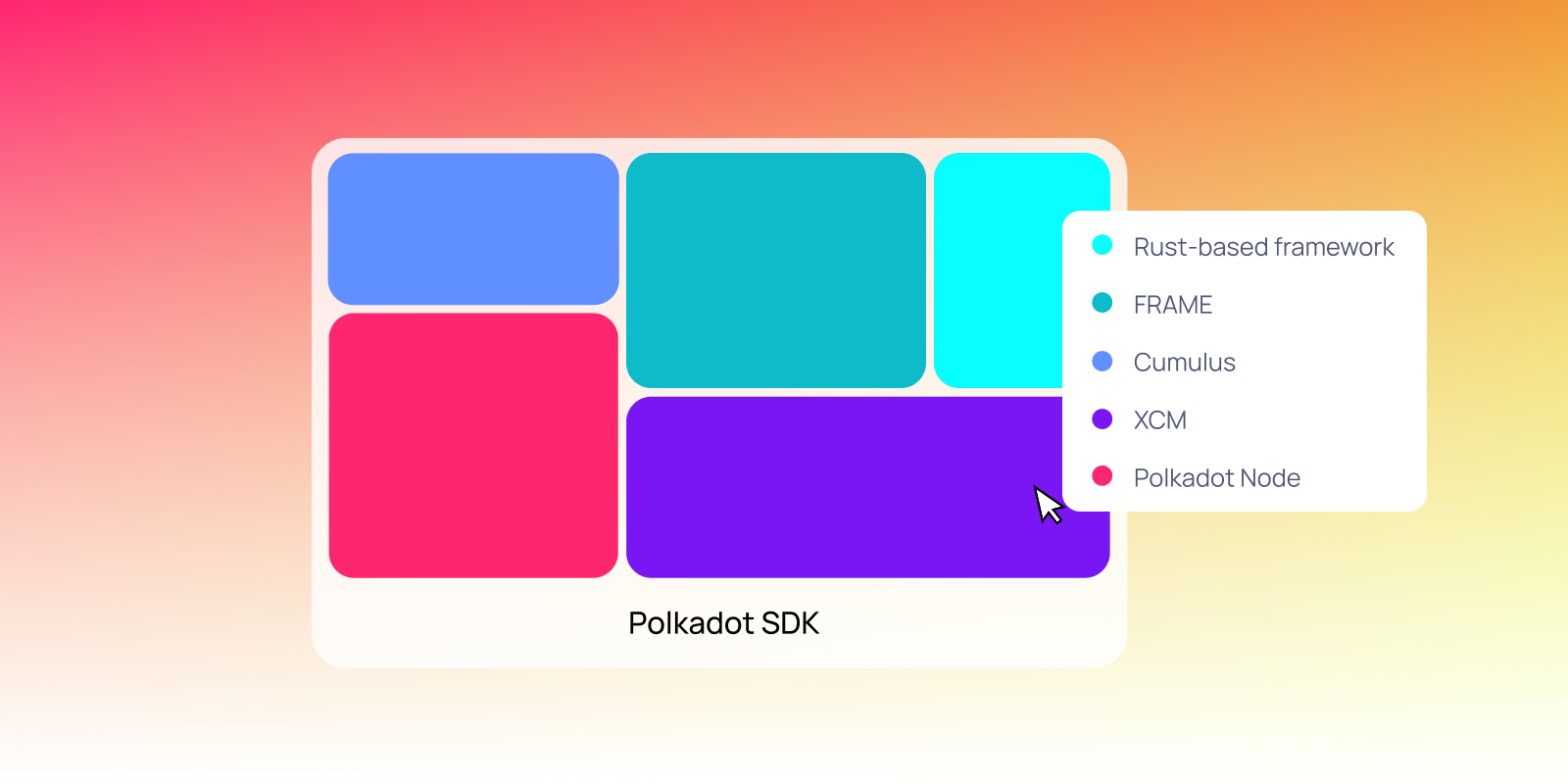
The SDK’s foundational components:
- Rust-based framework: Formerly known as Substrate, it provides modular, extensible libraries and tooling for blockchain development, including peer-to-peer networking, consensus, cryptography, and Wasm runtimes.
- FRAME: The runtime framework that lets developers assemble runtime logic using reusable modules (also known as pallets) or custom business rules.
- Cumulus: The layer that enables any FRAME-based runtime to become a Polkadot rollup, providing rollup functionality, validator integration, and connection to the Polkadot Chain.
- XCM (cross-consensus messaging): The native cross-chain messaging format, making it simple for SDK chains to move assets, share data, and trigger remote logic with other networks.
- Polkadot Node: The reference node implementation, delivering a robust networking and infrastructure stack for running validator or collator nodes.
Teams have the freedom to choose their deployment approach. Projects can connect as rollups to the Polkadot Chain and benefit from shared security and native interoperability. Alternatively, they can launch fully sovereign blockchains and appchains using custom runtime logic. By handling the underlying infrastructure, the SDK lets developers focus on what matters most: application logic, upgrade paths, and the user experience. As Jesse Morris, CEO of EnergyWeb, explains:
"We're not just deploying smart contracts on someone else's chain—we're building a fully custom execution environment tailored to the needs of the energy sector."
What makes the Polkadot SDK the best choice for builders?
Made for developers who want to ship fast without giving up customization or control, the SDK gives teams the ability to fine-tune every layer of their blockchain stack.
Here’s what sets it apart:
🧩 Modular and custom runtime logic
Developers have access to 40+ prebuilt runtime modules that cover core functions like staking, governance, balances, assets, and identity. Projects can configure, extend, or swap these self-contained, reusable modules, or create entirely new ones for use cases that demand unique business logic or protocol features.
🛠️ Custom execution
Teams can define their chain’s consensus mechanisms (BABE, Aura, GRANDPA, or custom options), execution logic, and staking models. Ideal for projects that need to optimize for throughput, finality, or real-time coordination, and equally suited for enterprise-grade deployments or experimental appchains.
🔁 Forkless upgrades
Projects can push new features, fix bugs, or evolve protocol logic without disruptive hard forks or downtime. Upgrades are managed through transparent onchain governance, so networks can evolve safely and with community buy-in.
⚖️ Native onchain governance
Onchain governance design is baked into the runtime. Whether it’s token voting, delegated councils, referenda, or custom mechanisms, governance is fully composable and customizable to fit specific community needs.
🔐 Shared security and rollup support
Launch securely with less overhead by connecting as a rollup to the Polkadot chain, inheriting robust, decentralized security from a global validator set. Projects that choose to remain sovereign still benefit from the full flexibility of the SDK, but are responsible for running their own validator set.
🌐 XCM for cross-chain interoperability
Projects that connect to Polkadot gain native interoperability, enabling chains to move assets, share data, and trigger remote calls securely. Alongside shared security, XCM makes it possible to build robust multichain applications without relying on bridges.
💻 Language flexibility
While Rust is the native language of the SDK, the framework is designed to be Wasm-compatible, opening the door to other languages and maximizing future-proofing.
🧱 Smart contracts
Projects can enable EVM or Wasm environments by including the right modules, or choose to launch a chain without smart contract functionality. Smart contract functionality is fully optional.
Looking ahead, developers will be able to deploy smart contracts that execute directly on Polkadot using either Wasm or the RISC-V based PolkaVM, unlocking even more flexibility and performance for programmable networks.
Who uses the SDK and what are they building?
Polkadot’s modular framework powers a broad spectrum of use cases. DeFi, identity, enterprise solutions, gaming, and DePIN are just a few areas where teams are building with full control and flexibility.
Here are a few standout examples:
- Mythical Games: A decentralized gaming platform that migrated from Ethereum to Polkadot to scale its Mythos blockchain, powering titles like NFL Rivals, FIFA Rivals, and Pudgy Party.
- Hydration: A DeFi rollup using custom runtime logic for liquidity and capital efficiency
- KILT: A decentralized identity (DID) protocol with bespoke staking and credentialing mechanisms.
- Pendulum: A stablecoin ready rollup with integrated forex feeds and real-world asset exposure.
- Aventus: An enterprise-grade rollup offering scalable blockchain integration for global businesses.
From consumer to enterprise, teams across the ecosystem have leveraged Polkadot’s tech stack to create purpose-driven solutions without starting from scratch. Ben Wittenburg, Cofounder of Hydration, shares:
“We function almost in the same way as a solo chain, but we just don’t have to worry about being 51% attacked or anything like that.”
What about the learning curve?
Polkadot’s approach to blockchain development offers lower-level control and greater flexibility than most platforms. The ecosystem actively lowers barriers to entry with a mature toolchain and robust resources:
- 🧰 Tools to run local testnets, trace and debug runtime logic, and optimize performance with built-in benchmarking
- 📖 Zero-to-Hero tutorials to step-by-step guidance.
- 📦 SDK templates to scaffold new chains and automate builds with standard Rust tools
- 📚 Comprehensive SDK docs for in-depth guides and open APIs for development and monitoring
- 💬 Community support Discord to connect with active developers
- 🛠️ Coming soon: Polkadot Deployment Portal (PDP) for one-click, no-code launching, configuration and management of Polkadot rollups
The foundation for scalable, modular chains
The Polkadot SDK is designed for modular, production-ready blockchain development. By unifying once-separate components, it brings everything needed to build fast, scalable and customizable rollups or appchains into a single, developer-friendly toolkit.
Whether your goal is building a rollup with custom economic logic, a sovereign chain focused on governance experimentation, or scaling enterprise infrastructure, the SDK equips developers with the tools to build for any use case.
Ready to build? Check out Polkadot’s developer docs, connect with developers in the community, and explore blockchain courses and tutorials.