
Polkadot Sustains Enterprise Momentum Alongside Native Web3 Innovation
Polkadot enjoyed a second quarter packed with major announcements as the network continues to forge ahead with a clear vision for Web3.
 By Oliver Brett•July 12, 2023
Polkadot, the blockspace ecosystem for boundless innovation, has enjoyed a second quarter studded with major announcements as the network continues to forge ahead with a clear vision for Web3.
It was another momentum-packed quarter that ended with the fourth edition of Polkadot Decoded, the annual flagship conference celebrating the ecosystem’s successes and pointing the way forward.
And many projects, including leading brands across multiple industries, joined Polkadot at an unprecedented scale having carefully considered the network’s many advantages over its rivals in the blockchain space.
Polkadot was the top Web3 protocol measured by development activity throughout the quarter, just as it had been in Q1, while there was another impressive rise in unique accounts, with almost four million now created across the ecosystem.
In terms of technical upgrades, the major highlight was the arrival of Polkadot OpenGov, bringing further decentralization to Polkadot’s governance by giving DOT holders control over the network’s future direction.
Enterprise adoption highlights included:
- Mythical Games, the number one gaming blockchain, announced its decision to leave Ethereum to launch its new “Mythos ecosystem” on Polkadot.
- Energy Web revealed its plans to join Polkadot to help big names like Shell, Vodafone and Volkswagen on their path to decarbonization.
- Polkadot parachain Frequency brought self-sovereign blockchain-based identities to the 20 million users of its social media platform MeWe. It also integrated censorship-resistant identity infrastructure from KILT, another Polkadot parachain.
- KILT was in the news again when it linked up with accounting giant Deloitte to issue reusable digital credentials for its KYC identity checks.
Further detail on these developments was provided at Polkadot Decoded, the flagship annual event for the ecosystem, which took place in Copenhagen, Denmark in late June. Meanwhile, the conference itself provided the backdrop for a raft of fresh announcements, such as:
- Vodafone’s blockchain lead David Palmer revealed sim cards linked to the Aventus parachain would be inserted into cargo tracking pods used by airlines. Up to 10% of these pods go missing, costing the aviation industry $400m annually. The development builds on Aventus’ existing relationship with Heathrow Airport.
- OpenZeppelin, the leading blockchain security company, is poised to open discussions with the Polkadot community on ambitious proposals to facilitate blockspace access. The company is keen to leverage its expertise gathered from building standard libraries for EVM-compatible chains.

- Astar unveiled details about Astar 2.0, an upgrade aimed at improving governance, staking, and infrastructure. Meanwhile, its developer Startale Labs benefited from a $3.5m investment from electronics giant Sony.
- KILT and Deloitte are working with Polimec, a new ecosystem team, to issue reusable KYC credentials, enabling access to global fundraising of digital assets.
- A partnership between Sovereign Nature Initiative and Moonsama will bring data about lions in Kenya into virtual realms, benefiting real-world conservation efforts.
- The Substrate-built peaq announced it was bringing Teslas into the Polkadot ecosystem via the car-sharing start-up ELOOP.
- Evrloot revealed its new game Stardust Colonies would be built on Ajuna Network — demonstrating the growth of builder activity at the application layer.
The statistical highlights
Dotinsights and the team at SubWallet published its first Polkadot Staking Report, covering the period between the launch of nomination pools in November 2022 to the end of May 2023. By the end of the quarter, 5.3m DOT had been bonded in pools, up from 3m DOT at the start of April and 12,265 pool members had begun actively bonding, up from 8,101.
Development activity remains exceptionally high, as recorded by Santiment. Polkadot continues to lead the way across Web3 in this metric, beating all other networks for all six months in 2023 for a total of 99,819 contributions in the year to date.
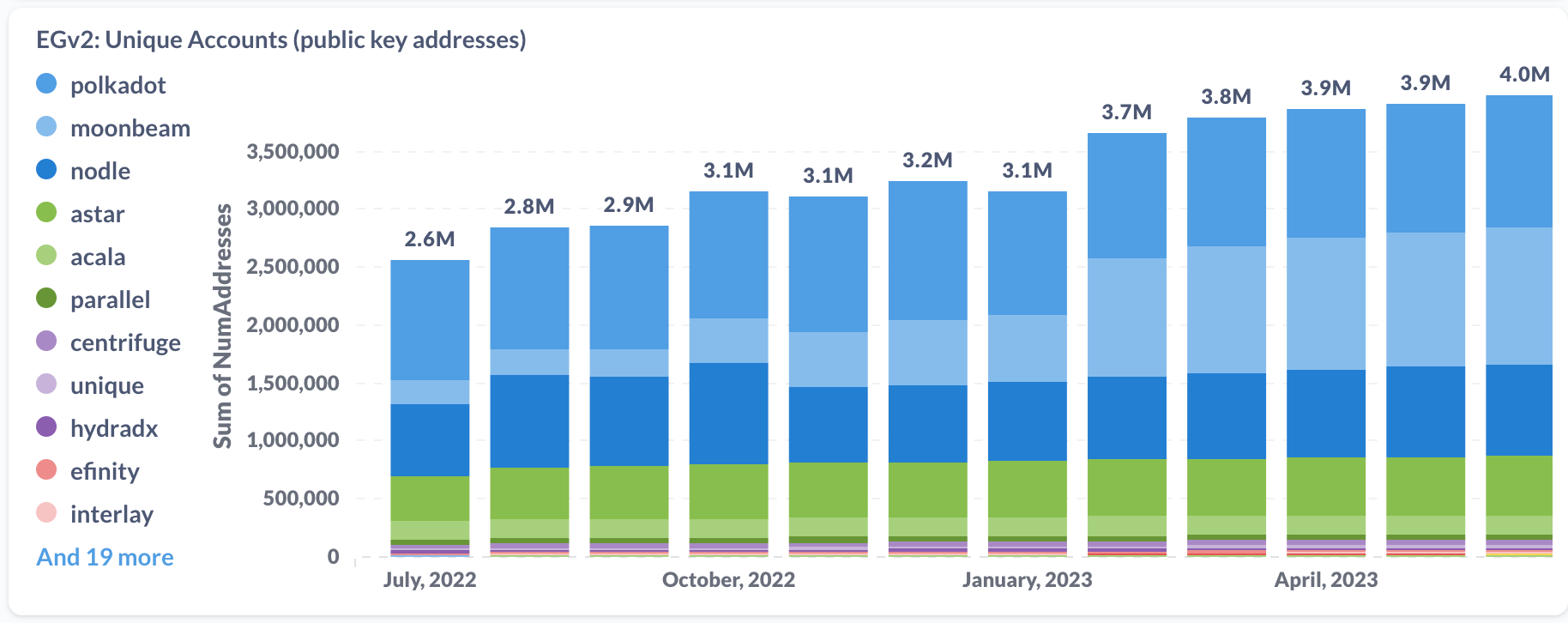
Across the Polkadot ecosystem, data collected by Parity Technologies demonstrates there were 3,983,145 unique accounts (public key addresses) by the end of June, up around 200,000 QoQ and up around 600,000 since the start of the year. The ecosystem averaged around 295,000 monthly active users, including extrinsic signers and token receivers.
Messari publishes optimistic quarterly report
Messari, a leading analyst in the crypto sector, with subscribers comprising investors, regulators, and the public, has published its own State of Polkadot report for Q2.
In its opening summary, it noted Polkadot’s native token DOT “was not flagged by the SEC as a security,” adding: “The omission follows the Web3 Foundation stating DOT had morphed and was no longer deemed a security after three years of discussions with the SEC.”
Messari concluded: “The network achieved two crucial milestones with the launches of Polkadot OpenGov and XCM v3. These releases hold immense potential to add value to the Polkadot network in the upcoming quarters. The network's fundamentals remained robust, and parachains experienced heightened levels of activity throughout the quarter. Acala and Moonbeam re-signed their slots, highlighting their continued commitment to the Polkadot ecosystem. Moreover, the migration of Mythical Games to Polkadot further underscores the platform's growing appeal. As the first batch of parachain leases is set to expire in October, the competition for parachain slots is expected to intensify as existing and new parachains vie for limited spots.”
DeFi and stablecoin news
- Binance began its support of USDT deposits and withdrawals on Polkadot, and the total volume of USDT on the Polkadot Asset Hub had surged by 125% in a day.
- It was announced Uniswap, the popular decentralized exchange, is coming to Polkadot via Moonbeam, increasing volume and liquidity across the ecosystem.
- Acala and Moonbeam won parachain auction slots 43 and 44 respectively, with the intention of renewing their leases for an additional two-year period. This will enable them to continue operating on the network uninterrupted until at least mid-2025.
Governance and technical upgrades
- Polkadot OpenGov went live on the network, handing over decision-making power to Polkadot’s decentralized community of DOT holders and enabling an advanced system of vote delegation for those who require it.
- XCM v3 was implemented, taking Polkadot’s cross-consensus messaging standard up a level. Parachain teams immediately tested XCM’s new capabilities - Zeitgeist announcing smart contract functionality in its prediction market protocol.
- Polkadot Vault, the ultra-secure air-gapped cold wallet formerly known as Parity Signer, underwent some significant updates including major UX improvements.
Web3 Foundation news
- Web3 Foundation revealed it had issued 36 new grants to projects during the quarter, for a total of 558 in its lifespan.
- W3F Chief Legal Officer, Daniel Schoenberger, was invited to testify on digital asset regulation before the U.S. House of Representatives.
- The Foundation announced a content production partnership with Primavera Pro, a collective of music industry professionals.
NFT news
- Mandala Metaverse, a new multi-platform game, selected Astar for its NFT drop
- The rights holders of The Wolf of Wall Street movie marked the 10-year anniversary of the blockbuster film with an NFT drop on the Aventus parachain.
- The winner of Parachain auction 42 was Moonsama, a project which accelerates the arrival of NFT-powered applications to the market by developing infrastructure and utility solutions.Want more? Watch 80+ talks from Polkadot Decoded now.
Interested in developing for or building on Polkadot? Get in touch for hands-on support.