
Polkadot Showcases Industry-Leading Scalability in Positive End to 2023
Polkadot’s final quarter of 2023 featured sustained organic growth, with pronounced spikes in transactional data in late December.
 By Oliver Brett•January 12, 2024
Polkadot’s final quarter of 2023 featured sustained organic growth, including pronounced spikes in transactional data in late December. Fees remained stable despite the network hitting record levels of daily activity.
This newly demonstrated scalability sets the network up for a year of enhanced enterprise adoption, at a time when projects like MeWe and Mythical Games are bringing large numbers of users into the ecosystem.
Along with some groundbreaking technical upgrades on the horizon, including trustless bridges, asynchronous backing, and on-demand parachains, these capabilities ensure it will be easier than ever for new ventures to join the ecosystem.
With initiatives like OpenGov and XCM now well established, and Agile Coretime poised to improve the way parachains connect to the network, a stronger than ever foundational framework is in place.
Inscriptions lead to record transaction figures
According to data from Subscan, transactions on the Polkadot Relay Chain rose from an average of just under 230,000 monthly DOT transactions in the first three quarters of 2023 to 378,868 in October and 339,865 in November, before leaping to 17,391,296 for December, smashing all previous records.
Commenting on the December spike, Polkadot founder Robert Habermeier posted on X on December 21st: “1 Million transactions today on the Polkadot relay chain. This is the highest activity day on Polkadot in history, topping out the 941,000 transactions on May 5, 2021. The activity is due to inscriptions.”
At the height of this user activity, Habermeier reported just shy of 13 million transactions in a 48-hour period during which time Polkadot’s Treasury, which is managed by its token holders, collected 110,000 DOT.
Fees remain stable despite increased demand
Crucially, the network was able to support this increased demand without the spike in transaction fees typically seen on other networks. Average daily transaction fees hovered close to 0.02 DOT for all of December.
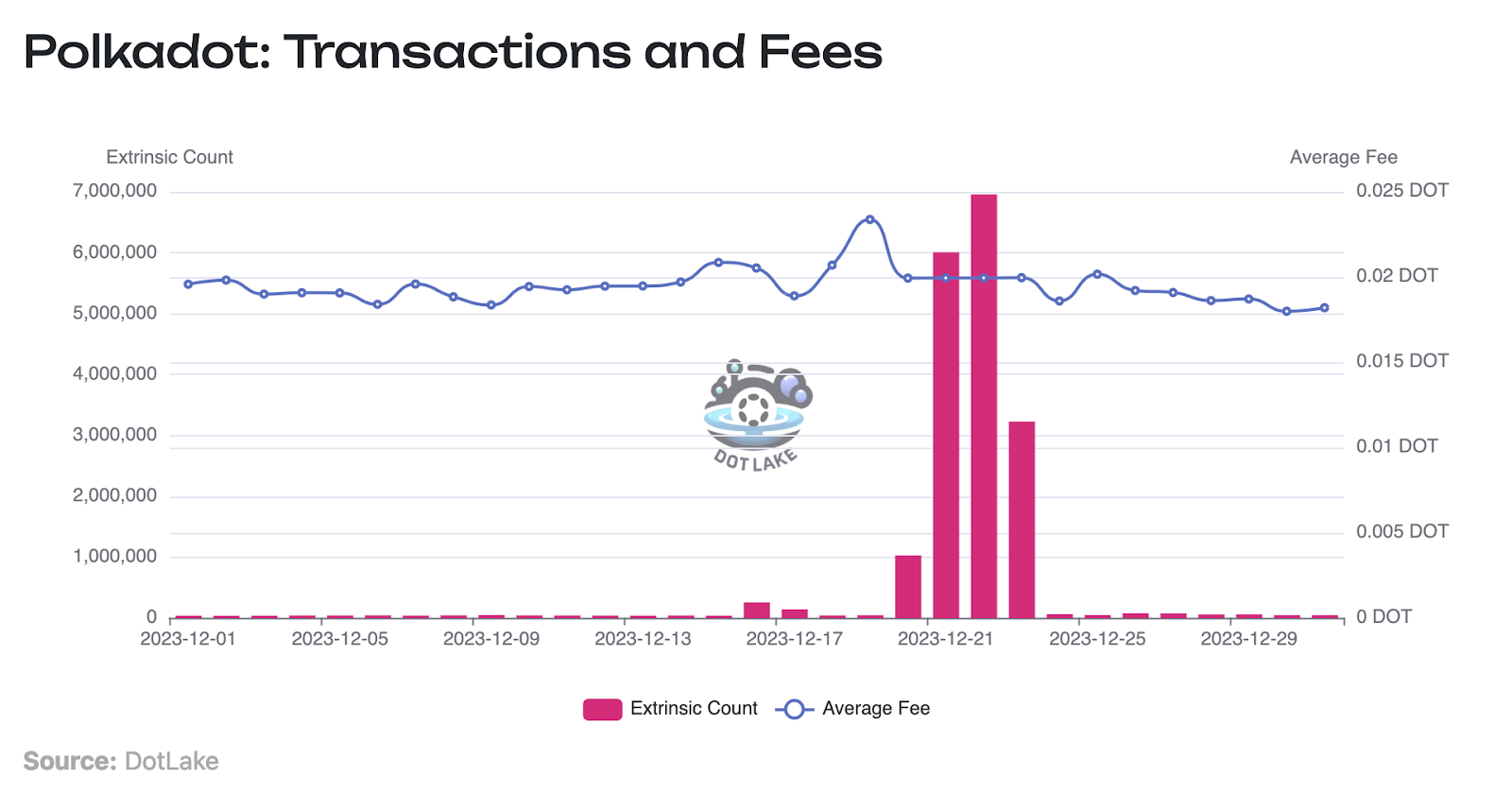
The chart above features data supplied by DotLake, a data platform reflecting activity on Polkadot and its ecosystem, and maintained by engineers and analysts at Parity Technologies. It indicates that fees remained stable, indicating the superior scalability offered by Polkadot in comparison to other networks.
Inevitably, those impressive transaction numbers were also reflected in other adoption metrics.
XCM, events & native USDC on the rise
Polkadot’s native cross-consensus messaging format, XCM, also saw a hike in activity in Q4. An average of around 17,000 messages were recorded per month from January to September; this doubled in October, hit 39,162 in November and then sprinted to 449,813 in December (all data per Subscan).
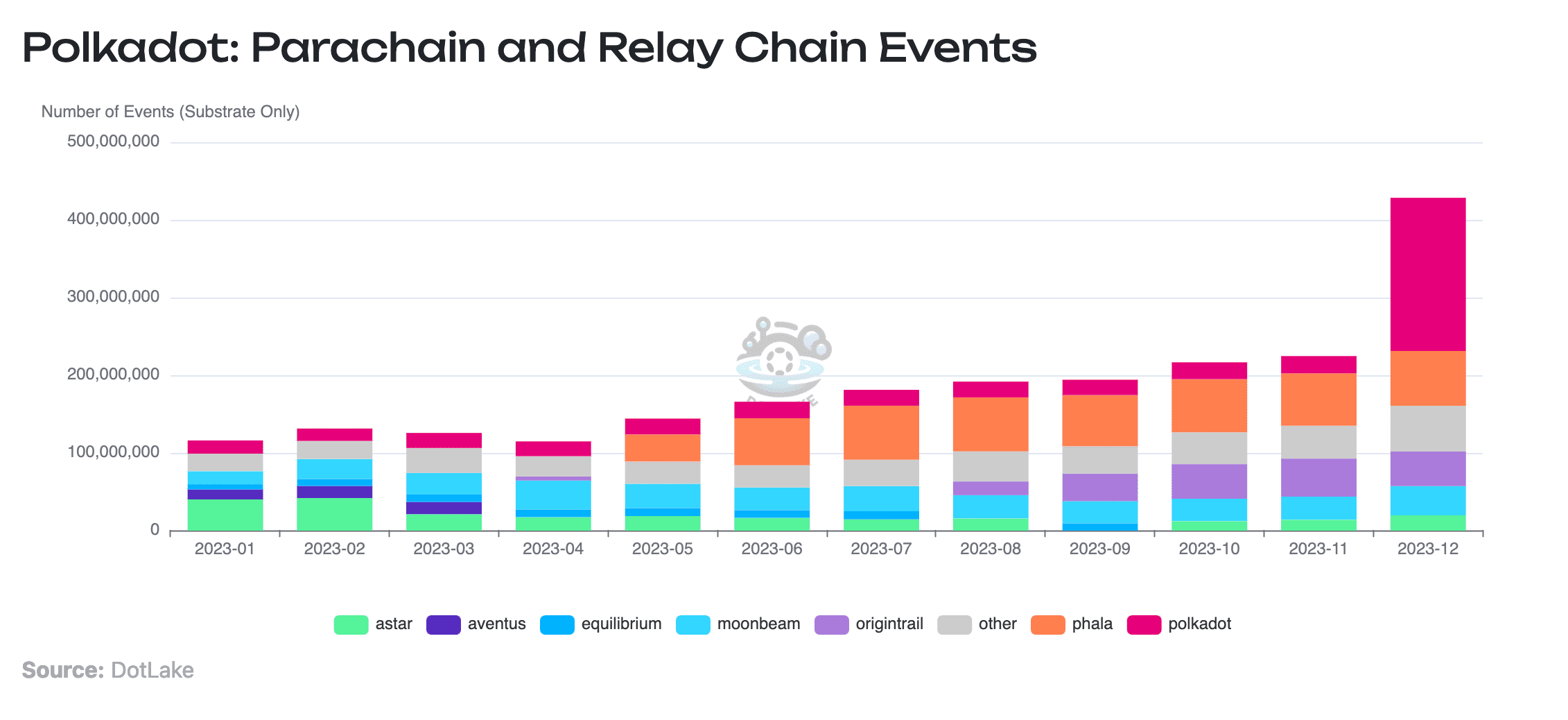
Similarly, the DotLake chart above indicates sustained growth in monthly on-chain “events” across Polkadot’s Relay Chain and parachains - and then a big December spike. Events include "outputs” from extrinsic calls such as transfers, swaps, and staking, or what most users would think of as actual transactions on the blockchain.
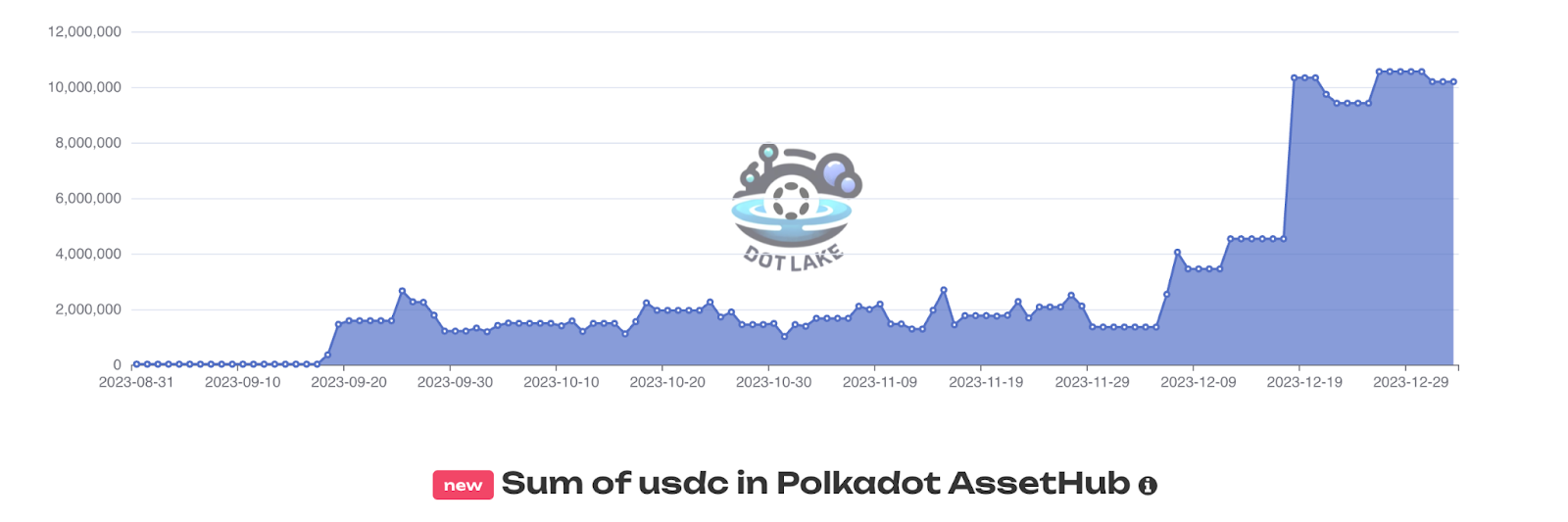
Native USDC entered the Polkadot ecosystem at the back end of Q3, but the effects of that were more fully felt in Q4 with more than $10m circulating on Polkadot Asset Hub by the end of the year (see chart above). HydraDX led support of native USDC from Polkadot’s parachains, with an additional $2.19m in circulation.
The ‘Great Unlock’ triggers staking surge
One aspect Parity’s data team looked closely at was the effect of an event known within the Polkadot community as “The Great Unlock”. During the first parachain auctions in October 2021, almost 100m DOT was locked in Acala, Moonbeam, Parallel, Astar and Clover. Those tokens were officially released on October 24th, 2023.
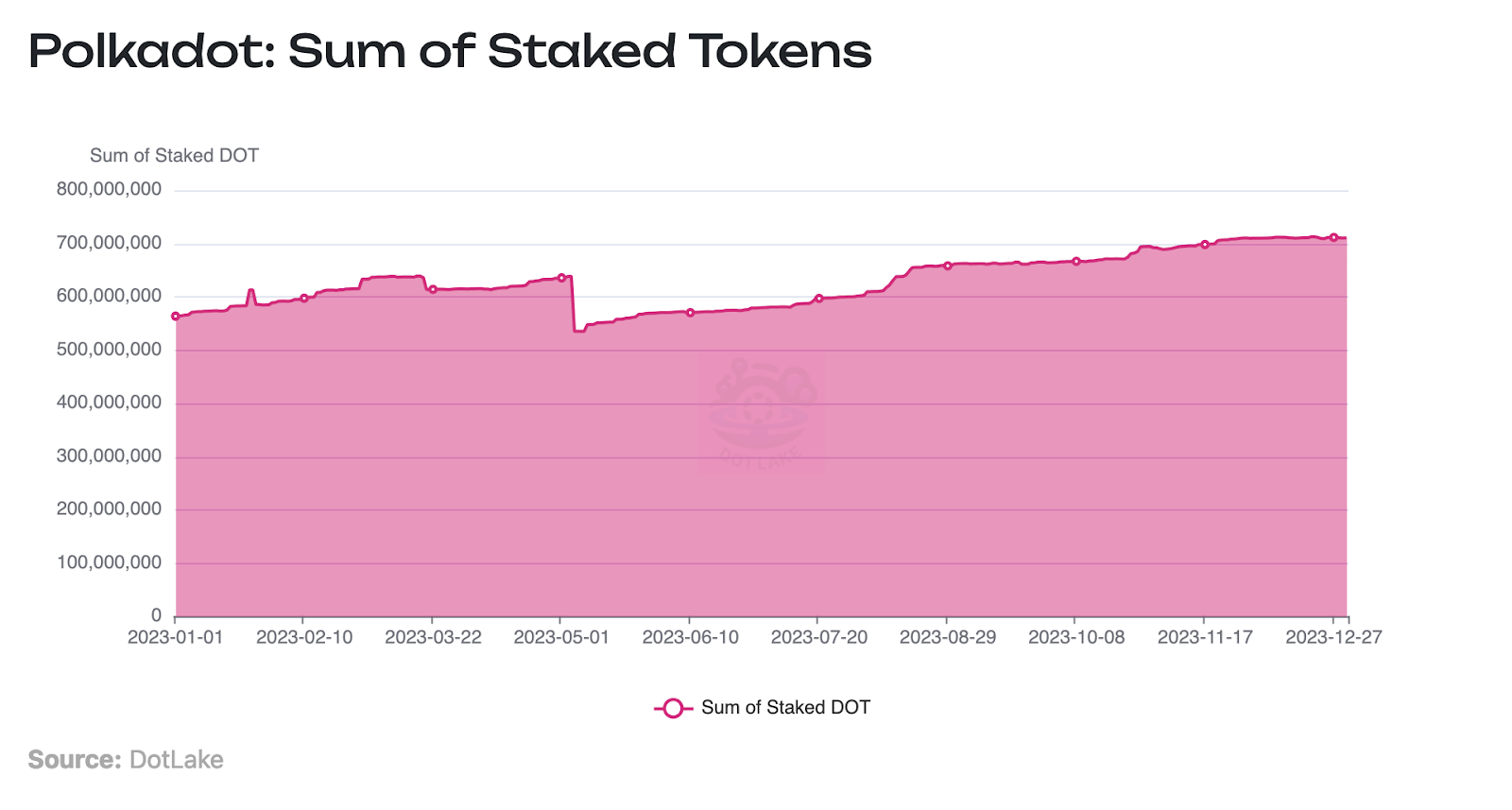
At this time, the number of tokens staked was 673m DOT, a number that rose to 709m by November 30th. A bump in the chart above is visible immediately after the unlock towards the end of October, with a continual rise to the end of November.
The year ended with a little over 710m DOT staked, or 50.9% of the total DOT supply, according to the Polkadot Staking Dashboard. Interest in pooled staking continues to rise steadily too, with nearly 23,000 people actively bonding in a total pool just shy of 12m DOT.
For even more data, you can see the first annual report published by Parity’s data team in December, a study packed with a wealth of written analysis and charts.
Gavin Wood’s 2023 Review
Polkadot founder Gavin Wood published his personal 2023 roundup at the end of December. He observed: “The Polkadot ecosystem continues to grow: Across Polkadot and Kusama we have 90 parachains from over 580 ecosystem projects; 300 of which are decentralised applications and 190 are Substrate-based blockchains.”
He also noted the release of technical upgrades, such as Asynchronous Backing, which has rolled out on Kusama with Polkadot to follow imminently. This is a development that more than doubles parachain block production and provides a performance boost for parachains of up to 800%.
Meanwhile, Agile Coretime is going live on testnets, and is expected on Kusama and Polkadot before the end of Q1 2024. As Wood explains: “Agile Coretime fundamentally alters the means by which Polkadot’s key resource — time on parachain cores — is acquired. Rather than long-term leases with difficult-to-predict deposits arrived at by auction, instead Coretime (as the resource is called) is sold off at more predictable prices in a monthly sale just ahead of usage.”
Also in the news this quarter
Agrotoken, the first global tokenization infrastructure for agricultural commodities, announced its plans to launch a Polkadot parachain. Agrotoken is a digital platform that issues stablecoins to farmers based on the dollar value of their crops - and they can exchange them for supplies, machinery or fuels, completing their transactions with credit and debit cards.
Snowbridge, a trustless bridge to connect Polkadot and Ethereum, is making significant strides with an imminent launch on the new Paseo testnet. The team is merging relevant pallets and support code into the Polkadot-SDK monorepo. Engineers expect full deployment to follow soon.
Logion, a pioneering blockchain platform that transforms digital assets into legal-grade evidence through a unique "Proof of Law" concept, has joined the Polkadot ecosystem by securing a parachain slot.
The Decentralized Futures program has been launched. This is a novel project aimed at supporting individuals and teams seeking to grow the Polkadot ecosystem - and the program has $20m in cash and 5m DOT tokens to distribute to successful applicants.