Results of DOT Redenomination Referendum
A referendum was just held on Kusama regarding whether or not to redenominate DOTs on Polkadot in a 1:100 ratio. Web3 Foundation used this referendum to gauge sentiment from the community before the launch of Polkadot.
 By Polkadot•May 15, 2020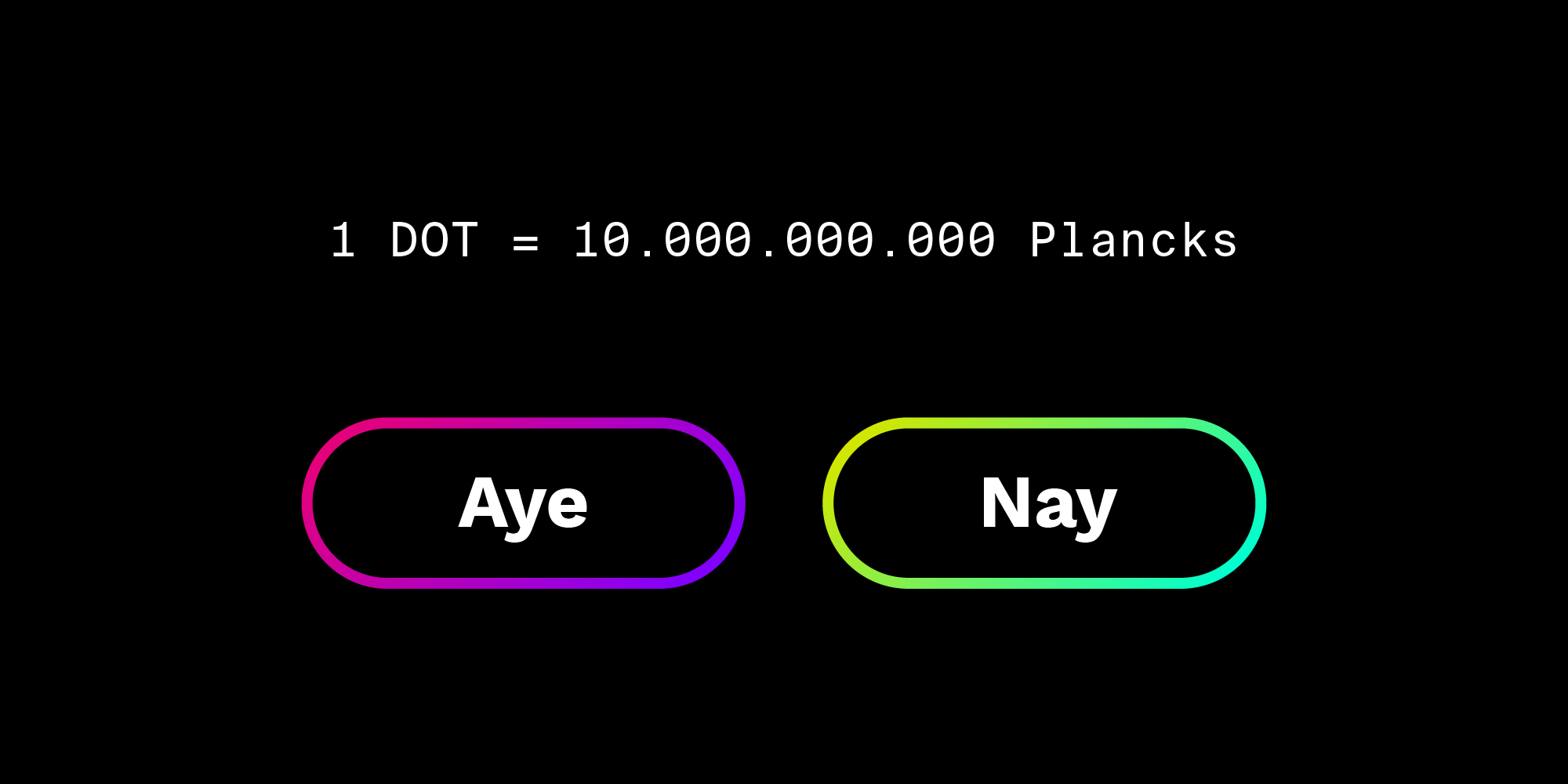
A referendum was just held on Kusama regarding whether or not to redenominate DOTs on Polkadot in a 1:100 ratio. Web3 Foundation used this referendum to gauge sentiment from the community before the launch of Polkadot.
The referendum, detailed on Polkassembly, would change the number of Plancks that constitute a single DOT. Plancks are the smallest unit of account in Polkadot, much like Satoshis in Bitcoin. Specifically, the referendum proposed changing a single DOT from one trillion Plancks per DOT to ten billion Plancks per DOT, a 100x decrease that would be offset by a 100x increase in the number of DOTs.
As such, the total number of Plancks in the system, and each DOT holder’s share of the network, would remain unchanged.
Among the benefits of this change would be the ability to deal with more ergonomic or human-readable units, like whole numbers rather than small decimals. Conversely, redenominating DOTs may cause confusion among DOT holders, which may prove fertile ground for scammers to take advantage. Some wallets and documentation may require updates, and it would also mean that DOTs would have a different precision than KSM (10 vs. 12, respectively).
Although the referendum was held on Kusama, it has no real effect on the Kusama network itself. The referendum will automatically enact seven days after the vote ended, and place a specific remark on the Kusama chain.
With turnout of more than 13%, this has been the most voted-on referendum in Kusama history, generating spirited discussions on Polkassembly, Riot, Twitter and elsewhere. Judging by this commentary and the voting activity, it appears that the Kusama community is broadly split and feels quite strongly about the referendum.
Though the referendum is not binding in any way, it allowed the Kusama stakeholders (who we see as largely, but not entirely, aligned with Polkadot stakeholders) to express their thoughts on the matter. Neither the Web3 Foundation nor Parity Technologies used its KSM to vote. With an impressively large turnout, a significant majority was recorded in favour of redenomination.
Informally, had the referendum recorded very little dissent, it is likely that Web3 Foundation, in its central role over the initial network launch, would have stood behind the redenomination proposal. However, given the non-negligible amount of opposition, including from some within the ranks of Web3 Foundation and Parity, the Foundation decided that we cannot, in good faith, sponsor redenomination at present.
From here, we see only two options: do nothing and allow the current denomination to stand, or conduct a final, binding vote on the Polkadot network itself. As proponents of self-determination and on-chain governance, the latter is our favoured option.
However, conducting a vote on denomination during the launch process, and specifically after genesis, would be quite a technical feat with great potential to cause confusion all round. As such, it is not something we will condone without a reasonable belief that it will not cause major problems. We will be researching the technicalities of the matter, canvassing key community stakeholders and infrastructure providers, and monitoring the usual social media channels on the matter to determine if such a vote could be safely executed.
Web3 Foundation and the Polkadot community have learned several lessons from the referendum. The Democracy pallet that Kusama uses has several issues when being used purely to signal intention. It was designed to make decisions that directly impact the chain in question, and some features that enhance this capability (such as time-locked conviction voting) are suboptimal from the point of view of determining sentiment regarding another chain.
Turnout was extremely high for an on-chain vote, showing that users of the network care about this topic and that stakeholders will vote on essential governance topics.
Learn More
Learn More about Kusama's Governance on the Wiki.
Join the discussion on Telegram and Riot, or subscribe to the newsletter. Learn more about Polkadot in the Polkadot Lightpaper and the Polkadot Wiki.