The First Polkadot Vote…
A vote has been started that will alter the course of Polkadot and define the final denomination of its native DOT token. It affects all Polkadot stakeholders. If you have claimed your DOT on the mainnet, or you plan to, then you can — and should! — vote.
 By Dr. Gavin Wood•July 13, 2020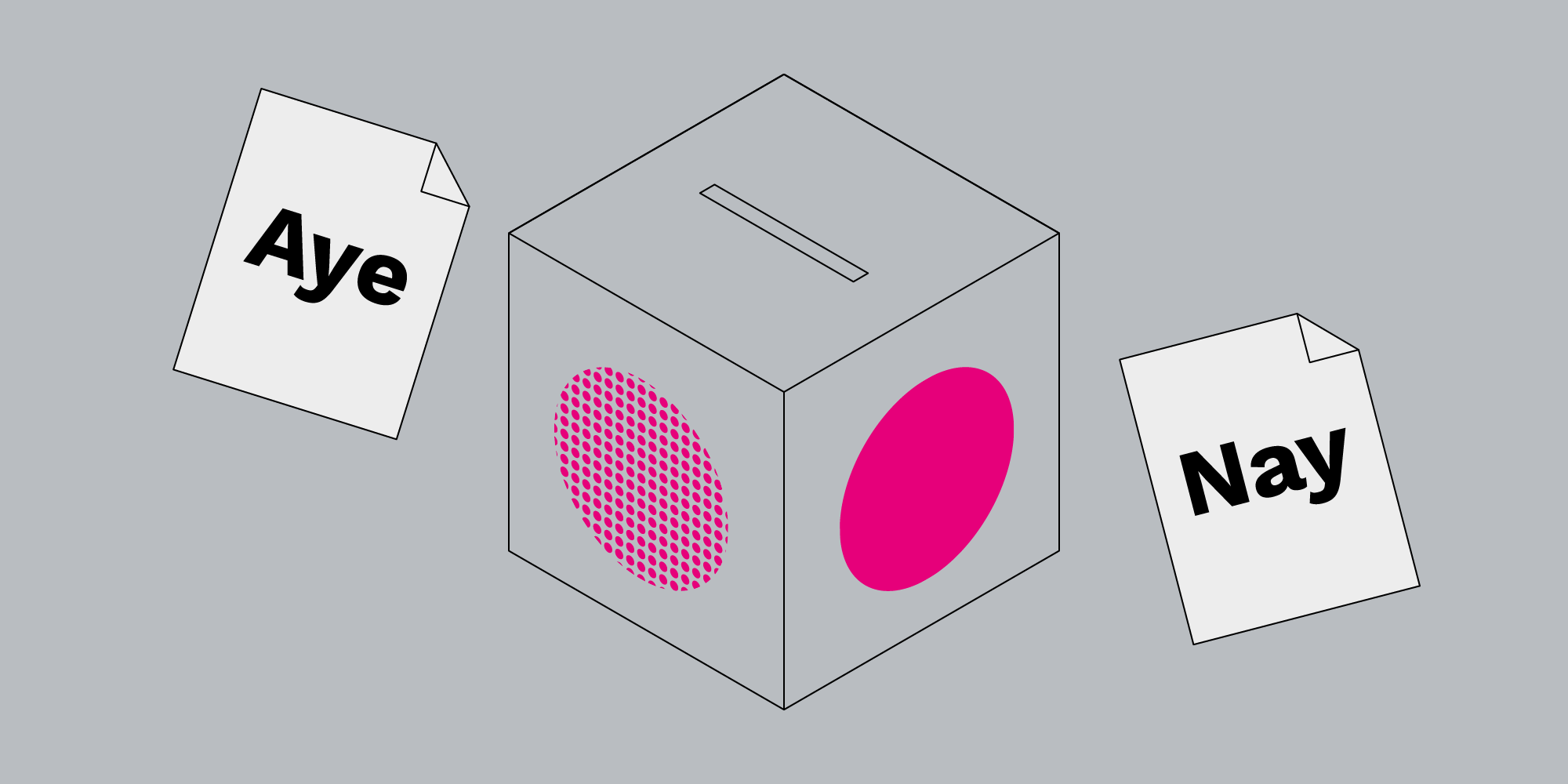
A vote has been started that will alter the course of Polkadot and define the final denomination of its native DOT token. It affects all Polkadot stakeholders. If you have claimed your DOT on the mainnet, or you plan to, then you can — and should! — vote.
Two months ago, a vote was conducted on Polkadot’s “wild cousin” network, Kusama. The vote was over a simple, non-binding declaration that the assembled Kusama community be in favor of changing the denomination of the “DOT” token, essentially multiplying all balances across the system by one hundred. The result was a resounding “yes”, albeit with a sizable minority contingent against it, and voices questioning why it should be 100 and not 10 or 1000.
Although there was clearly a large degree of support for it, the Web3 Foundation decided that the voting population of Kusama might reasonably be sufficiently different to that of Polkadot that the results could not be blindly enacted. That said, the Foundation undertook to do further research and, if reasonable, reconduct the vote on Polkadot with real DOT tokens.
Research
The Foundation reached out to a wide variety of community members and Polkadot stakeholders to determine potential practical issues regarding a redenomination. This included prospective token ecosystem stakeholders such as exchanges as well as established community leaders. The outcome was fairly simple;
- Infrastructure providers were generally sanguine about practical issues concerning a redenomination after launch and supported the effort, though (obviously) would prefer for it to happen before launch or hours within launch to minimize their own workload and risk.
- Community leaders indicated that some community stakeholders may have some degree of reliance on the DOT denomination remaining unchanged from the 2017 sale lest the meaning of what constitutes a “DOT” be misunderstood.
Our preference would have been to make a vote on the denomination whose outcome was, more or less, instantly enacted and done before transferability. Unfortunately, our research indicated that this may cause some substantial problems within the Polkadot community.
Three options were considered:
- Keep DOT the same and introduce a new name (e.g. XPD) for the new denomination and encourage all to use the new denomination instead. This has the disadvantage of losing the “DOT” name.
- Try to distinguish the old DOT from the new DOT with some sort of “year” naming system — DOT2017 vs DOT2020. It is unclear that this would actually provide enough clarity to avoid any problems.
- Provide a “grace period” after transfers are enabled, to avoid any confusion or ambiguity on Day 1 regarding the original DOT denomination. This means switching the denomination while the system is fully “live”.
After a long period of discussions, the Foundation decided that the only option it could reasonably back was option 3.
Proposal
In the next days, we will begin a final, “binding” vote on the redenomination. We encourage all members of the community to discuss and put forth their views (politely!).
In the interests of simplicity and accessibility, a single poll will happen. Four options will be provided and may be voted upon via the Polkadot.js user interface as well as any wallets that build in support. The poll is open now and will last for two weeks. All DOT holders will be able to take part.
The poll will be a simple approval vote with four options. Important notes:
- Any combination of the four options may be approved of by the voter. There is no need to select only one option!
- Approving of all or none of the options is equivalent and will not affect the outcome.
- All voters may alter their votes any number of times prior to the close of the poll.
- Voting costs nothing other than the transaction fee and can be done from all accounts with a non-zero spendable balance. (If you managed to lock up all of your funds in staking to the point that none is left for transacting and you would like to vote, please contact a representative of the Web3 Foundation.)
- Locked funds (e.g. for staking) are counted.
- No discretionary lock-voting is in place; all DOT used to vote counts the same.
- Voting is made on a per-account basis; a single account must all vote the same way and cannot split its vote.
- This vote does not affect any economics of the Polkadot platform. Staking rewards, inflation, effective market capitalization and the underlying balances of every account remain completely unchanged. It is “merely” about what units we use to denominate the balances into “DOT” for the purpose of display.
From 43,200 blocks (approximately 72 hours) after DOT tokens become transferable, the DOT token shall be denominated according to whichever option received the most approvals. The grace period was chosen as the optimal time that was acceptable across ecosystem stakeholders.
The four options being polled are:
- No change from the original 2017 sale definitions; will mean a total of 10m DOT from genesis.
- Split of 10x from the original sale; will mean a total of 100m DOT from genesis. Apparent DOT price would be 10x lower.
- Split of 100x from the original sale; will mean a total of 1b DOT from genesis. Apparent DOT price would be 100x lower.
- Split of 1,000x from the original sale; will mean a total of 10b DOT from genesis. Apparent DOT price would be 1000x lower.
If we take the original 2017 sale price of $32/DOT, then these four options would result in an equivalent price of $32 (no change), $3.20, $0.32 and $0.032 respectively.
Any change will happen entirely off-chain, exclusively at the user-interface layer, since the chain logic only tracks the underlying balance in Plank units (Polkadot’s lowest denomination), and doesn’t care about the denomination that is displayed. The Foundation will give further updates on anything for community stakeholders to be aware of should this happen, technical information &c.
Head over to Riot to chat about this proposed change. Head to Polkadot JS Apps, for claiming and voting. More information on Polkadot can be found on its website. The latest v0.8 client release may be found on the GitHub releases page.