Web3 funding playbook for builders, creators, and founders
Discover funding opportunities in the Polkadot ecosystem, from grants and bounties to venture capital and community-driven fundraising. Explore pathways for builders at every stage, with insights on securing support for DeFi, DePIN, AI, gaming, and real-world asset tokenization.
 By Meesh Nguyen•March 17, 2025
Originally published March 17, 2025 | Updated September 26, 2025
What you can expect
- What's changing in the funding landscape?
- Choosing the right funding path
- Featured funding programs
- Roundup of funding opportunities
- FAQ
You’ve put in the work—experimenting, refining, and pushing boundaries. Whether you’re building your first dapp, scaling a Web3 startup, or expanding into new markets, securing the right funding can be the key to unlocking your project's next stage of growth
Polkadot’s funding ecosystem goes beyond grants and bounties. It’s a dynamic network of resources that evolves alongside the builders shaping it. From accelerator programs and venture capital to community-driven platforms and onchain funding, multiple pathways exist to fuel innovation at every stage.
New funding initiatives continue to emerge, expanding access for builders in DeFi, DePIN, AI, RWA, gaming, and beyond. Whether you need capital to test an idea, develop a product, or scale infrastructure, understanding your funding options is key.
This fresh take on Polkadot’s funding landscape highlights why now is the perfect time to revisit available opportunities. New grants, bounties, and decentralized funding streams have emerged, offering even more ways for teams to bring their ideas to life.
What is changing in the funding landscape
Polkadot’s funding model is continuously evolving, introducing new opportunities while refining existing programs to align with long-term decentralization goals. Recent shifts in funding priorities reflect broader Web3 trends and the need for scalable infrastructure.
Evolving ecosystem priorities
Beyond core infrastructure funding, Polkadot’s funding mechanisms are placing renewed emphasis on:
- DePIN & sustainability: Supporting projects that decentralize real-world infrastructure, from connectivity solutions to distributed energy networks, with a focus on sustainable mechanisms.
- AI & data integrity: Promoting projects that leverage Polkadot’s composability to enhance AI dapps, data sharing protocols, and automation layers, including privacy-preserving AI and verifiable onchain data.
- Cross-chain gaming & digital assets: Encouraging the proliferation of interoperable blockchain games with crypto rails, including digital asset ownership and mobility, smart contract composability across different rollups, and real-world asset tokenization.
Expanding opportunities and access
As new funding streams emerge, existing programs are expanding to increase accessibility:
- Higher funding caps from the Polkadot Treasury: Larger treasury allocations now support infrastructure-level projects with wider ecosystem impact, making onchain governance a more powerful funding tool.
- Accelerator programs: Emerging initiatives designed to help startups enter new markets, fine-tune product-market fit, and strengthen business development strategies.
- Funding platforms & growth initiatives: Beyond direct funding, Polkaport East drives investor relations and business development in Asia, creating more opportunities for startups and ecosystem builders.
Choosing the right funding path
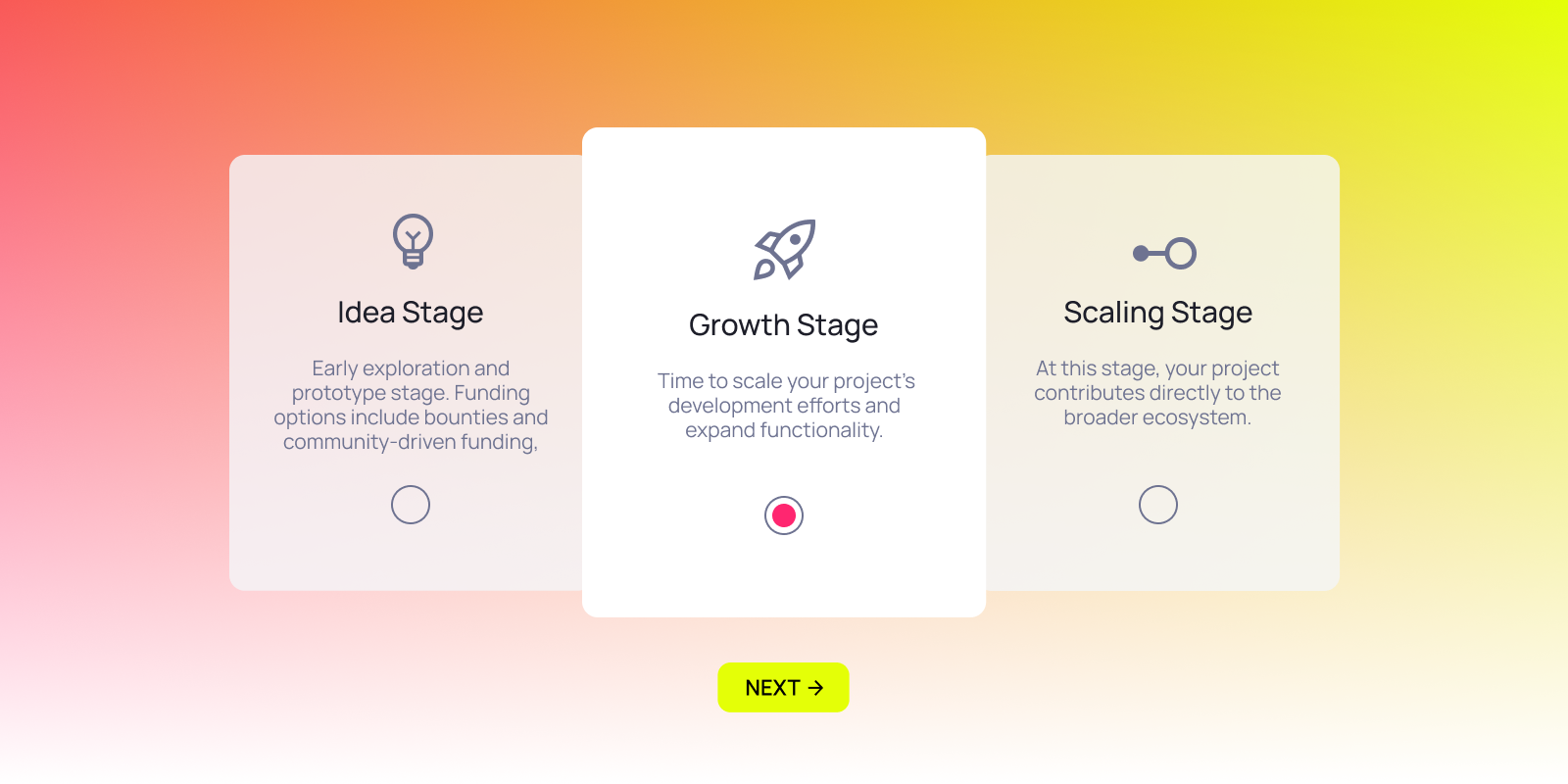
Polkadot offers a range of funding avenues tailored to different stages of project growth. Whether you're validating an idea, developing a product, or scaling infrastructure, choosing the right mechanism can make all the difference.
🌱 Idea stage: Early exploration and prototyping
For projects in the early phases of development, securing quick-access funding can help validate concepts and build proof-of-concept solutions.
- Bounties: Best for developers or small teams tackling specific technical challenges within the Polkadot ecosystem. Bounties provide task-based rewards and often have faster payouts than grants. For example, the Polkadot DeFi Infrastructure & Tooling Bounty funds key ecosystem tooling and infrastructure development.
- Community fundraising: Crowdfunding platforms offer decentralized fundraising, enabling projects to raise capital directly from the community without relying on grants or VCs. This model helps build an early support network while securing initial resources.
Contributing to bounties helps establish credibility and demonstrate technical expertise, which can strengthen future grant applications.
🪴Growth stage: Development and expansion
Once a project moves beyond the prototype phase, securing structured funding can help with product development, integration, and market positioning.
- Network development grants: Programs like the Web3 Foundation Grants Program fund projects that enhance Polkadot and Kusama, particularly those focused on infrastructure, interoperability, and security.
- Ecosystem-specific programs: Individual rollups, such as peaq, Moonbeam, and Pendulum, offer grants for projects building directly on their networks. These grants often come with technical mentorship and ecosystem support.
Before applying for a grant, check the specific focus areas and eligibility requirements of the funding program. Some grants prioritize infrastructure, while others focus on DeFi, AI, or gaming.
🌳 Scaling stage: Expanding ecosystem impact
At this stage, funding options focus on scaling operations, driving ecosystem impact, and increasing market reach.
- Venture Capital (VC): Firms like Scytale and Harbour Industrial Capital invest in Web3 startups, providing funding, strategic guidance, and access to their networks. VC funding can be ideal for projects aiming to expand rapidly but may require giving up equity or token allocations.
- Polkadot Treasury: The Polkadot Treasury, governed by OpenGov, funds projects that provide long-term ecosystem value. This includes infrastructure development, tooling, education, and ecosystem-wide initiatives. Treasury funding is community-approved and requires submitting a proposal.
- Advanced bounties: Large-scale bounties, such as the Dot Play Bounty for Gaming, fund long-term development efforts, particularly in gaming, creator-focused applications, and infrastructure tooling.
Treasury funding requires community approval, so engaging with the Polkadot community—whether through forums, governance discussions, or direct feedback—can help refine your proposal and improve its chances of success.
Navigating Polkadot’s funding landscape means building connections, engaging with the community, and scaling strategically. Many successful projects combine multiple sources, using bounties to kickstart development, grants for structured progress, and VC funding to scale.
Featured funding programs
Polkadot’s funding ecosystem includes a range of structured programs designed to help builders at every stage. The following section highlights key opportunities by the Web3 Foundation for funding, mentorship, technical resources, and strategic support.
- Open Source Developer Grants Program: Treasury-funded initiative that supports individuals and small teams in developing open-source software for the Polkadot ecosystem.
- Polkadot x ERA Global Program: 12-week entrepreneurial accelerator program in partnership with Entrepreneurs Roundtable Accelerator (ERA) designed to help Polkadot startups scale and break into the U.S. market. The inaugural pilot runs from Feb 17th to mid-May 2025 in NYC and combines intensive mentorship, a structured business curriculum, and valuable industry connections.
- W3F Grants Program: Long-running funding initiative (since 2019) that supports software development and research projects enhancing the Polkadot ecosystem through quarterly selection waves. The program offers tiered funding while providing recipients with ecosystem connections and promotional opportunities.
- JAM Prize: 10 million DOT and 100,000 KSM to develop multiple implementations of JAM (Join-Accumulate Machine)—the new protocol designed to succeed the Polkadot Chain—with enhanced smart contract functionality. Structured around five progressive milestones, the JAM Prize encourages experienced development teams to create compatible clients across diverse programming environments—from OCaml and Go to Zig—with graduated achievement levels that progressively enhance the ecosystem's technical foundation and resilience.
Roundup of funding opportunities
Polkadot offers a diverse range of funding options to support builders at every stage. Whether you're launching a new project, expanding infrastructure, or scaling a product, these programs provide capital, mentorship, and technical resources to help drive innovation.
Network development & innovation funds
Funding for projects and stuff that elevates the Polkadot network as a whole.
- Polkadot Ecosystem Fund: Led by Scytale, an industry-leading digital asset manager and investment firm focused on accelerating early-stage blockchain and crypto projects. Their portfolio includes notable Polkadot projects like Astar and Centrifuge, and they recently launched their dedicated Polkadot Ecosystem Fund to support projects building on Polkadot and its rollups.
- Polkadot Ecosystem Fund II: A separate initiative by Harbour Industrial Capital focusing on venture capital and liquid investment strategies. They focus on strategic investments in growth-stage companies, co-investments with external VCs, and early-stage (pre-seed/seed) funding through equity and tokens, with a portfolio including peaq, Mythical, and Mandala.
- Decentralized Futures: a comprehensive funding program by the W3F that supports both profit-generating organizations and non-profit ventures across technology, marketing, and business development, with the strategic goal of expanding initiatives within the Polkadot ecosystem.
- Polkadot DeFi Infra & Tooling Bounty: Initiated by Velocity Labs, the bounty allocates ~$4M to accelerate the development of essential infrastructure components like token infrastructure, chain abstraction solutions, and onboarding tools, that address Polkadot adoption barriers.
- Polkadot Assurance Legion (PAL): A non-profit community initiative with the mission to promote and advance open-source security in the Polkadot ecosystem. PAL supports security audits, vulnerability research, and best practices for secure development across Polkadot projects.
- Games Bounty Grants Program: Initiated by Dot Play, the program connects talented developers with resources to build on Polkadot. Join the "New Superstars" community and receive tailored financial support for ecosystem tools and game creation. The accelerator prioritizes mass-market, creator-driven projects with global potential.
Ecosystem-specific programs
- Acala Ecosystem Program: Provides financial backing and comprehensive support for vetted early-stage startups building solutions that integrate Acala's protocols. Recipients benefit from technical mentorship, ecosystem connections, and strategic guidance.
- Aleph Zero’s Ecosystem Funding Program: Launched in 2024, the program is designed to support projects from proof-of-concept and early-stage companies to experienced teams with their own solutions deployed on different platforms. The program offers four tracks from a grants pool of $45M, with the goal of expanding the capabilities and adoption of the Aleph Zero chain.
- Avail’s Grants Program: funds developers working on ecosystem-enhancing projects, offering RFP-based grants for targeted development and micro-grants for open-source contributions. Focused on improving infrastructure, tooling, and cryptographic research, the program supports free, open-source, and non-commercial initiatives that drive positive-sum outcomes.
- Darwinia Grants & Bounty Program: The grants program provides financial support for cross-chain development for projects at various stages, while the bounty program encourages community developers to contribute by addressing issues and enhancing functionality on the Darwinia Chain and Msgport.
- Hydration Grants & Bounties Program: Offer incentives for contributions such as bug fixes, development work, and translations, with rewards up to $100,000 in HDX. The program is overseen by the Hydration Council, which ensures that funding is allocated effectively to drive ecosystem growth and innovation.
- peaq’s DePIN Grants Program: Designed to support early-stage projects focused on decentralized physical infrastructure networks (DePIN), enabling developers to build innovative applications and tools. By funding these initiatives, peaq aims to expand its ecosystem and integrate more physical infrastructure onchain.
- Moonbeam’s Innovation Fund: A $10 million initiative dedicated to advancing key areas like gaming and real-world assets (RWAs) on its platform. The fund also allocates resources to support the Moonriver network, providing grants for ecosystem development and infrastructure improvements.
- Pendulum Grants Program: Focused on bridging the gap between fiat and DeFi ecosystems by supporting the development of critical infrastructure like AMMs, lending protocols, and stable fiat tokens. The program offers financial and technical support to projects building on Pendulum's fiat-optimized blockchain.
Start and scale your project with the right funding
The Polkadot ecosystem continues to evolve, offering new and expanded funding opportunities for builders, creators, and innovators at every stage of their journey. Whether you're just beginning to prototype your idea, scaling infrastructure for mass adoption, or exploring cutting-edge areas like AI, DePIN, or GameFi, there's a funding path to help bring your project to life.
If you're looking for a comprehensive overview of previous funding programs, check out the 2024 Polkadot Grants and Funding Guide, which covers past opportunities. Keep in mind that some information may now be outdated as the ecosystem continues to grow and shift.
FAQ
What’s the difference between grants and bounties?
Grants and bounties both provide funding, but they serve different purposes.
- Grants are for larger, structured projects that contribute long-term value to the ecosystem. They typically require an application process, milestones, and deliverables before distributing funds. Examples include ecosystem-wide grants from the Web3 Foundation or ecosystem-specific grants from rollups like peaq, Pendulum, and Moonbeam.
- Bounties are task-based incentives that reward contributors for solving specific challenges. Unlike grants, they don’t require an extensive proposal—just the ability to complete the task. Bounties are great for developers looking to contribute to key ecosystem initiatives while getting paid for their work. The Polkadot DeFi Infrastructure & Tooling Bounty is an example, funding critical ecosystem tooling sometimes with a faster payout model than grants.
TLDR: Grants support long-term projects with structured funding, while bounties offer one-off rewards for completing defined tasks or milestones.
Are there any funding opportunities for non-technical creators in the Polkadot ecosystem?
Yes! While many grants and bounties focus on development, there are funding opportunities for non-technical contributors, including community builders, educators, and content creators.
- The Polkadot Treasury funds marketing, educational content, and community initiatives, with proposals voted on through OpenGov.
- Polkaport East supports Polkadot adoption in Asia, creating opportunities for networking, business development, and ecosystem engagement.
Should I seek venture capital or community-driven funding?
It depends on your project’s goals, timeline, and how much ownership you’re willing to trade.
- Venture Capital is ideal for high-growth projects that need substantial capital, strategic guidance, and access to industry networks. However, VC funding often comes in exchange for equity or tokens, which means giving up some level of ownership or control. Firms like Scytale and Harbour Industrial Capital invest in Polkadot-based startups, providing both funding and strategic support.
- Community-driven funding is more decentralized, allowing projects to raise funds directly from the Web3 community. This approach fosters organic adoption and long-term engagement but may take more effort to gain traction.